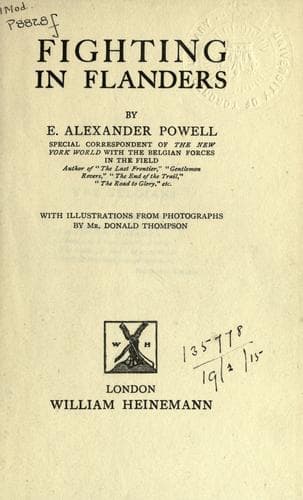
Fighting in FlandersPowell, E. Alexander (Edward Alexander)
History
Fighting in Flanders
Powell, E. Alexander (Edward Alexander)
World War, 1914-1918 -- Campaigns -- Belgium
"Well, Herr Powell," he said, laughing, "we will think about it. And,"
he continued gravely, "I trust that you will tell the American people,
through your great paper, what I have told you to-day. Let them
hear our side of this atrocity business. It is only justice that they
should be made familiar with both sides of the question."
I have quoted my conversation with General von Boehn as nearly
verbatim as I can remember it. I have no comments to make. I will
leave it to my readers to decide for themselves just how convincing
were the answers of the German General Staff--for General von
Boehn was but its mouthpiece--to the Belgian accusations. Before
we began our conversation I asked the general if my photographer,
Thompson, might be permitted to take photographs of the great
army which was passing. Five minutes later Thompson whirled
away in a military motor-car, ciceroned by the officer who had
attended the army school at Fort Riley. It seems that they stopped
the car beside the road, in a place where the light was good, and
when Thompson saw approaching a regiment or a battery or a
squadron of which he wished a picture he would tell the officer,
whereupon the officer would blow a whistle and the whole column
would halt.
"Just wait a few minutes until the dust settles," Thompson would
remark, lighting a cigar, and the Ninth Imperial Army, whose
columns stretched over the country-side as far as the eye could
see, would stand in its tracks until the air was sufficiently clear to get
a good picture.
A field battery of the Imperial Guard rumbled past and Thompson
made some remark about the accuracy of the American gunners at
Vera Cruz.
"Let us show you what our gunners can do," said the officer, and he
gave an order. There were more orders--a perfect volley of them. A
bugle shrilled, eight horses strained against their collars, the drivers
cracked their whips, the cannoneers put their shoulders to the
wheels, and a gun left the road and swung into position in an
adjacent field. On a knoll three miles away an ancient windmill was
beating the air with its huge wings. A shell hit the windmill and tore it
into splinters.
"Good work," Thompson observed critically. "If those fellows of
yours keep on they'll be able to get a job in the American navy when
the war is over."
In all the annals of modern war I do not believe that there is a
parallel to this little Kansas photographer halting, with peremptory
hand, an advancing army and leisurely photographing it, regiment
by regiment, and then having a field-gun of the Imperial Guard go
into action solely to gratify his curiosity.
Public-domain text, read in full here on John Shaqi.
Reviews
Reviews
No reviews yet
Be the first to share your thoughts on this work.
Join the Discussion
Join the discussion
Sign in to leave a comment or review.
Sign InorCreate an account