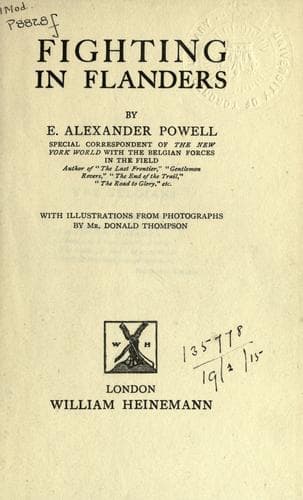
Fighting in FlandersPowell, E. Alexander (Edward Alexander)
History
Fighting in Flanders
Powell, E. Alexander (Edward Alexander)
World War, 1914-1918 -- Campaigns -- Belgium
They were very courteous and hospitable to me, those German
officers, and I was immensely interested with all that I saw. But,
when all is said and done, they impressed me not as human beings,
who have weaknesses and virtues, likes and dislikes of their own,
but rather as parts, more or less important, of a mighty and highly
efficient machine which is directed and controlled by a cold and
calculating intelligence in far-away Berlin. That machine has about
as much of the human element as a meat-chopper, as a steam-
roller, as the death-chair at Sing Sing. Its mission is to crush,
obliterate, destroy, and no considerations of civilization or chivalry or
humanity will affect it. I think that the Germans, with their grim, set
faces, their monotonous uniforms, and the ceaseless shuffle,
shuffle, shuffle of their boots must have gotten on my nerves, for it
was with a distinct feeling of relief that I turned the bonnet of my car
once more towards Antwerp and my friends the Belgians.
VI. On The Belgian Battle-Line
In writing of the battles in Belgium I find myself at a loss as to what
names to give them. After the treaty-makers have affixed their
signatures to a piece of parchment and the arm-chair historians
have settled down to the task of writing a connected account of the
campaign, the various engagements will doubtless be properly
classified and labelled--and under the names which they will receive
in the histories we, who were present at them, will probably not
recognize them at all. Until such time, then, as history has granted
them the justice of perspective, I can only refer to them as "the fight
at Sempst" or "the first engagement at Alost" or "the battle of
Vilvorde" or "the taking of Termonde." Not only this, but the
engagements that seemed to us to be battles, or remarkably lifelike
imitations of battles, may be dismissed by the historians as
unimportant skirmishes and contacts, while those engagements that
we carelessly referred to at the time as "scraps" may well prove, in
the light of future events, to have been of far greater significance
than we realized. I don't even know how many engagements I
witnessed, for I did not take the trouble to keep count. Thompson,
who was with me from the beginning of the campaign to the end,
told a reporter who interviewed him upon his return to London that
we had been present at thirty-two engagements, large and small.
Though I do not vouch, mind you, for the accuracy of this assertion,
it is not as improbable as it sounds, for, from the middle of August to
the fall of Antwerp in the early part of October, it was a poor day that
didn't produce a fight of some sort. The fighting in Belgium at this
stage of the war may be said to have been confined to an area
within a triangle whose corners were Antwerp, Aerschot and
Termonde. The southern side of this triangle, which ran somewhat
to the south of Malines, was nearly forty miles in length, and it was
Public-domain text, read in full here on John Shaqi.
Reviews
Reviews
No reviews yet
Be the first to share your thoughts on this work.
Join the Discussion
Join the discussion
Sign in to leave a comment or review.
Sign InorCreate an account