Transcriber’s Notes
Phrases printed in bold face, italics or small capitals in the
source document have been transcribed between =equal signs= or
_underscores_, or as ALL CAPITALS for this e-text.
More Transcriber’s Notes may be found at the end of this e-text.
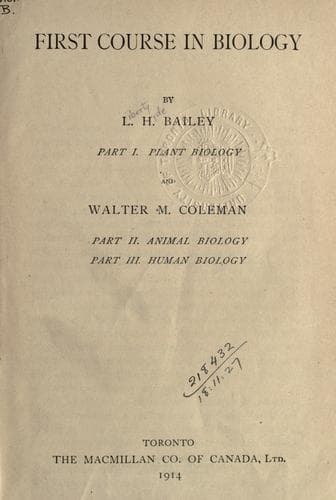
FIRST COURSE IN BIOLOGY
[Illustration]
THE MACMILLAN COMPANY
NEW YORK · BOSTON · CHICAGO
ATLANTA · SAN FRANCISCO
MACMILLAN & CO., LIMITED
LONDON · BOMBAY · CALCUTTA
MELBOURNE
THE MACMILLAN CO. OF CANADA, LTD.
TORONTO
[Illustration: KENTISH PLOVER WITH EGGS AND YOUNG (PROTECTIVE
RESEMBLANCE)
From the Exhibit in the British Natural History Museum. (Morgan.)]
FIRST COURSE IN BIOLOGY
BY
L. H. BAILEY
_PART I. PLANT BIOLOGY_
AND
WALTER M. COLEMAN
_PART II. ANIMAL BIOLOGY_
_PART III. HUMAN BIOLOGY_
New York
THE MACMILLAN COMPANY
1909
_All rights reserved_
COPYRIGHT, 1908,
BY THE MACMILLAN COMPANY.
Set up and electrotyped. Published July, 1908. Reprinted
October, 1908; February, September, 1909.
Norwood Press
J. S. Cushing Co.--Berwick & Smith Co.
Norwood, Mass., U.S.A.
PREFACE
The present tendency in secondary education is away from the formal
technical completion of separate subjects and toward the developing
of a workable training in the activities that relate the pupil to his
own life. In the natural science field, the tendency is to attach less
importance to botany and zoology and physiology as such, and to lay
greater stress on the processes and adaptations of life as expressed
in plants and animals and men. This tendency is a revolt against the
laboratory method and research method of the college as it has been
impressed into the common schools, for it is not uncommon for the pupil
to study botany without really knowing plants, or physiology without
knowing himself. Education that is not applicable, that does not put
the pupil into touch with the living knowledge and the affairs of his
time, may be of less educative value than the learning of a trade in a
shop. We are coming to learn that the ideals and the abilities should
be developed out of the common surroundings and affairs of life rather
than imposed on the pupil as a matter of abstract, unrelated theory.
One of the marks of this new tendency in education is the introduction
of unit courses in biology in the secondary schools, in the place of
the formal and often dry and nearly meaningless isolated courses in
botany, zoology, and physiology. This result is one of the outcomes of
the recent nature-study discussions.
Public-domain text, read in full here on John Shaqi.
Reviews
Reviews
No reviews yet
Be the first to share your thoughts on this work.
Join the Discussion
Join the discussion
Sign in to leave a comment or review.
Sign InorCreate an account