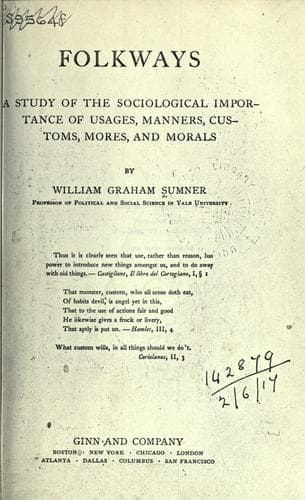
Folkways: A Study of the Sociological Importance of Usages, Manners, Customs, Mores, and MoralsSumner, William Graham
General
Folkways: A Study of the Sociological Importance of Usages, Manners, Customs, Mores, and Morals
Sumner, William Graham
Manners and customs
+105. The correction of aberrations.+ It is possible to arrest or avert
such an aberration in the mores at its beginning or in its early stages.
It is, however, very difficult to do so, and it would be very difficult
to find a case in which it has been done. Necessarily the effort to do
it consists in a prophecy of consequences. Such prophecy does not appeal
to any one who does not himself foresee error and harm. Prophets have
always fared ill, because their predictions were unwelcome and they were
unpopular. The pension system which has grown up in the United States
since the civil war has often been criticised. It is an abuse of extreme
peril in a democracy. Demagogues easily use it to corrupt the voters
with their own money. It is believed that it will soon die out by its
own limitations. There is, however, great doubt of this. It is more
likely to cause other evil measures, in order that it may not die out.
If we notice the way in which, in this case, people let a thing go on in
order to avoid trouble, we may see how aberrant mores come in and grow
strong.
+106. Mores of advance or decline.+ Seeck thinks that a general
weariness of life in the Greco-Roman world caused indifference to
procreation. It accounts for the readiness to commit suicide and for the
indifference to martyrdom. Life was hardly worth having. He says that
during the whole period of the empire there was no improvement in the
useful arts, no new invention, and no new device to facilitate
production. Neither was there any improvement in the art of war, in
literature, or the fine arts. As to transportation and commerce there
seems to have been gain in the first centuries of the Christian
era.[123] Such inventions as were made required a very long time to work
their way into general use. This sluggishness is most apparent in mental
labor. After the time of Hadrian science cannot be said to have existed.
The learned only cited their predecessors. Philosophy consisted in
interpreting old texts. The only gains were in religion, and those all
were won by Semites or other peoples of western Asia.[124] Both Greeks
and Romans exterminated the _elite_ of their societies, and pursued a
policy which really was a selection of the less worthy.[125] Men fled
from the world. They wanted to get out of human society. They especially
wanted to escape the state. The reason was that they suffered pain in
society, especially from the political institutions. The Christian
church gave to this renunciation of social rights and duties the
character of a religious virtue. "Pessimism took possession of the old
peoples at the beginning of the Christian era. This world is regarded as
delivered over to destruction. Men long for a better life and the
immortality of the gods, outside of this transitory existence. To this
sentiment corresponds the division of the universe into a world of light
above, the realm of the good, and a world of darkness below, where the
evil powers dwell.
Public-domain text, read in full here on John Shaqi.
Reviews
Reviews
No reviews yet
Be the first to share your thoughts on this work.
Elsewhere in the archive
Join the Discussion
Join the discussion
Sign in to leave a comment or review.
Sign InorCreate an account