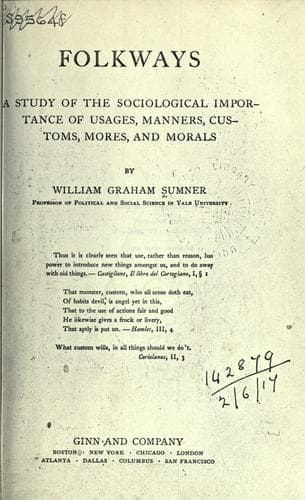
Folkways: A Study of the Sociological Importance of Usages, Manners, Customs, Mores, and MoralsSumner, William Graham
General
Folkways: A Study of the Sociological Importance of Usages, Manners, Customs, Mores, and Morals
Sumner, William Graham
Manners and customs
Men live in a middle space. Myths explained how our
world arose as a mixture of good and evil, between the two realms of
good and evil. Man belongs to both; to the world of light by his soul,
to the world of darkness by his body. Men struggle for redemption from
this world and from carnality, and long to soar through the series of
the heavens, so as to come before the face of the highest God, there to
live forever. This one can do after death, if he has during life
undergone the necessary consecration, and has learned the words which
can open heaven for him. In order to impart the consecration, and break
the powers of darkness, one of the higher gods, the Redeemer-God,
himself descended to earth. This religious theory is held by secret
sects. The folk religions are dead. They can no longer satisfy the wants
of men. Those of the same faiths and sentiments meet in secret
brotherhood. The East must have been full of such secret sects, which
corresponded to the petty states of the earlier period."[126] There was
a very widespread opinion that the world was old and used up so that it
could produce no more, just as a woman beyond her prime could no longer
bear children.[127] "Whenever in any people, consciousness of its
decline becomes vivid, a strange tendency to self-destruction arises in
it. This is not to be explained scientifically, although it has been
often observed." The best commit suicide first, for they do not fear
death.[128] Romans of wealth and rank committed suicide in the first and
second century with astonishing levity; Christians, of the masses, went
to martyrdom in the same way. Pliny expresses the feeling that life had
little or no value.[129]
+107. The Greek temper in prosperity.+ The Greeks, until the fourth
century before Christ, were characterized by the joy of life. They lived
in close touch with nature, and the human body was to them not a clog or
a curse, but a model of beauty and a means of participating in the
activities of nature. Their mores were full of youthful exuberance.
Their life philosophy was egoistic and materialistic. They wanted to
enjoy all which their powers could win, yet their notion of _olbos_ was
so elevated that our modern languages have no word for it. It meant
opulence, with generous liberality of sentiment and public spirit. "I do
not call him who lives in prosperity, and has great possessions, a man
of _olbos_, but only a well-to-do treasure keeper."[130] Such were the
mores of the age of advance in wealth, population, military art,
knowledge, mental achievement, and fine arts,--all of which evidently
were correlative and coherent parts of an expanding prosperity and
group life.
Public-domain text, read in full here on John Shaqi.
Reviews
Reviews
No reviews yet
Be the first to share your thoughts on this work.
Elsewhere in the archive
Join the Discussion
Join the discussion
Sign in to leave a comment or review.
Sign InorCreate an account