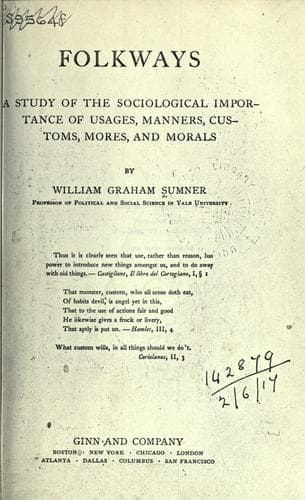
Folkways: A Study of the Sociological Importance of Usages, Manners, Customs, Mores, and MoralsSumner, William Graham
General
Folkways: A Study of the Sociological Importance of Usages, Manners, Customs, Mores, and Morals
Sumner, William Graham
Manners and customs
+109. Greek degeneracy.+ The decline of the Greeks in the three
centuries before our era is so great and sudden that it is very
difficult to understand it. The best estimate of the population of the
Peloponnesus in the second century B.C. puts it at one hundred and nine
per square mile.[135] Yet the population was emigrating, and population
was restricted. A pair would have but one or two children. The cities
were empty and the land was uncultivated.[136] There was neither war
nor pestilence to account for this. It may be that the land was
exhausted. There must have been a loss of economic power so that labor
was unrewarded. The mores all sank together. There can be no achievement
in the struggle for existence without an adequate force. Our
civilization is built on steam. The Greek and Roman civilization was
built on slavery, that is, on an aggregation of human power. The result
produced was, at first, very great, but the exploitation of men entailed
other consequences besides quantities of useful products. It was these
consequences which issued in the mores, for, in a society built on
slavery as the form of productive industry, all the mores, obeying the
strain of consistency, must conform to that as the chief of the
folkways. It was at the beginning of the empire that the Romans began to
breed slaves because wars no longer brought in new supplies.[137] Sex,
vice, laziness, decline of energy and enterprise, cowardice, and
contempt for labor were consequences of slavery, for the free.[138] The
system operated, in both the classical states, as a selection against
the superior elements in the population. This effect was intensified by
the political system. The city became an arena of political struggle for
the goods of life which it was a shame to work for. Tyrannies and
democracies alternated with each other, but both alike used massacre and
proscription, and both thought it policy to get rid of troublesome
persons, that is, of those who had convictions and had courage to avow
them. Every able man became a victim of terrorism, exerted by idle
market-place loafers. The abuse of democratic methods by
those-who-had-not to plunder those-who-had must also have had much to do
with the decline of economic power, and with the general decline of joy
in life and creative energy. It would also make marriage and children a
great and hopeless burden. Abortion and sex vice both directly and
indirectly lessened population, by undermining the power of
reproduction, while their effect to destroy all virile virtues could not
fail to be exerted.[139] It was another symptom of disease in the mores
that the number of males in the Roman empire greatly exceeded the
number of females.[140] The Roman system used up women.
Public-domain text, read in full here on John Shaqi.
Reviews
Reviews
No reviews yet
Be the first to share your thoughts on this work.
Elsewhere in the archive
Join the Discussion
Join the discussion
Sign in to leave a comment or review.
Sign InorCreate an account