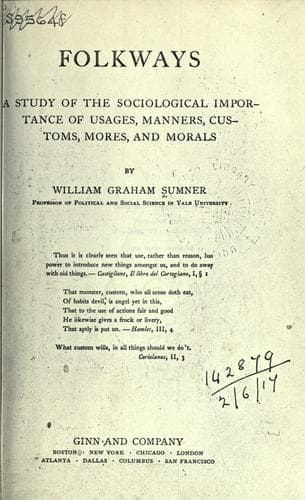
Folkways: A Study of the Sociological Importance of Usages, Manners, Customs, Mores, and MoralsSumner, William Graham
General
Folkways: A Study of the Sociological Importance of Usages, Manners, Customs, Mores, and Morals
Sumner, William Graham
Manners and customs
+136. Language and magic.+ Preuss offers an explanation of the origin of
language which is interesting on account of its connection with the vast
operation of magic: "Language owes its origin to the magic of tones and
words. The difficulty of winning any notion about the beginnings of
human speech lies in the fact that we cannot think of any cause which
should give occasion for speech utterances. Such occasions are products
of education, after language already existed. They are effects of
language, not causes of it.... Language belongs, like play, dances, and
fine arts, to the things which do not come on a direct line of
development out of the instinctive satisfaction of life-needs and the
other activities which create things of positive value, but it is the
result of belief in magic, which prompted men to imitate noises made in
labor, and other natural sounds, through a wide range, in order thereby
to produce operations."[241]
+137. Language is a case of mores.+ Whitney said that language is an
institution. He meant that it is in the folkways, or in the mores, since
welfare is connected with the folkways of language, albeit by some
superstition. He adds: "In whatever aspect the general facts of language
are viewed, they exhibit the same absence of reflection and
intention."[242] "No one ever set himself deliberately at work to invent
or improve language,--or did so, at least, with any valuable and abiding
result. The work is all accomplished by a continual satisfaction of the
needs of the moment, by ever yielding to an impulse and grasping a
possibility, which the already acquired treasure of words and forms, and
the habit of their use, suggest and put within reach."[243] "Every
single item of alteration, of whatever kind, and of whatever degree of
importance, goes back to some individual or individuals who set it in
circulation, from whose example it gained a wider and wider currency,
until it finally won that general assent, which is alone required in
order to make anything in language proper and authoritative."[244] These
statements might be applied to any of the folkways. The statements on
page 46 of Whitney's book would serve to describe and define the mores.
This shows to what an extent language is a case of the operation by
which mores are produced. They are always devices to meet a need, which
are imperceptibly modified and unconsciously handed down through the
generations. The ways, like the language, are incorporeal things. They
are borne by everybody and nobody, and are developed by everybody and
nobody. Everybody has his little peculiarities of language. Each one has
his peculiarities of accent or pronunciation and his pet words or
phrases. Each one is suggesting all the time the use of the tricks of
language which he has adopted. "Nothing less than the combined effort of
a whole community, with all its classes and orders, in all its variety
of characters, circumstances, and necessities, is capable of keeping in
Public-domain text, read in full here on John Shaqi.
Reviews
Reviews
No reviews yet
Be the first to share your thoughts on this work.
Elsewhere in the archive
Join the Discussion
Join the discussion
Sign in to leave a comment or review.
Sign InorCreate an account