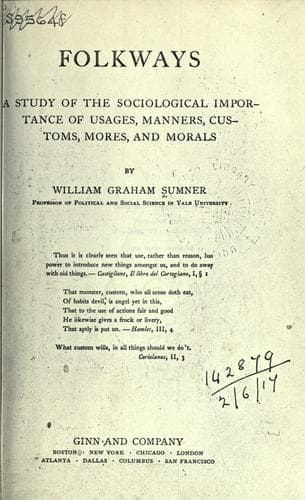
Folkways: A Study of the Sociological Importance of Usages, Manners, Customs, Mores, and MoralsSumner, William Graham
General
Folkways: A Study of the Sociological Importance of Usages, Manners, Customs, Mores, and Morals
Sumner, William Graham
Manners and customs
life a whole language."[245] "Every vocable was to us [children] an
arbitrary and conventional sign; arbitrary, because any one of a
thousand other vocables could have been just as easily learned by us and
associated with the same idea; conventional, because the one we acquired
had its sole ground and sanction in the consenting use of the community
of which we formed a part."[246] "We do not, as children, make our
language for ourselves. We get it by tradition, all complete. We think
in sentences. As our language forms sentences, that is, as our
mother-tongue thinks, so we learn to think. Our brain, our entire
thought-status, forms itself by the mother-tongue, and we transmit the
same to our children."[247] Nature men have only petty coins of speech.
They can express nothing great. They cannot compare, analyze, and
combine. They are overwhelmed by a flood of details, in which they
cannot discern the ruling idea. The material and sensual constitute
their limits. If they move they have to get a new language. The American
languages are a soft mass which changes easily if tribes separate, or as
time goes on, or if they move their habitat.[248] Sometimes measures are
adopted in order to make the language unintelligible, as the Bushmen
insert a syllable in a word to that end.[249] "The language of nature
peoples offers a faithful picture of their mental status. All is in
flux. Nothing is fixed or crystallized. No fundamental thoughts, ideas,
or ideals are present. There is no regularity, logic, principles,
ethics, or moral character. Lack of logic in thinking, lack of purpose
in willing or acting, put the mind of a nature man on a plane with that
of our children. Lack of memory, antilogic, paradox, fantasy in mental
action, correspond to capriciousness, levity, irresponsibility, and the
rule of emotions and passions in practical action."[250] "Man's language
developed because he could make, not merely passive and mechanical
associative and reproductive combinations of notions, like a beast, but
because he had active, free, and productive apperceptions, which appear
in creative fantasy and logical reflection."[251] "Man does not speak
because he thinks. He speaks because the mouth and larynx communicate
with the third frontal convolution of the brain. This material
connection is the immediate cause of articulate speech."[252] This is
true in the sense that speech is not possible until the vocal organs are
present, and are duly connected with the brain. "The specific cry,
somewhat modified by the vocal resources of man, may have been
sufficient for the humble vocabulary of the earliest ages, and there
exists no gulf, no impassable barrier, between the language of birds,
dogs, anthropoid apes, and human speech."[253] "The warning or summoning
cry, the germ of the demonstrative roots, is the parent of the names of
number, sex, and distance; the emotional cry of which our interjections
Public-domain text, read in full here on John Shaqi.
Reviews
Reviews
No reviews yet
Be the first to share your thoughts on this work.
Elsewhere in the archive
Join the Discussion
Join the discussion
Sign in to leave a comment or review.
Sign InorCreate an account