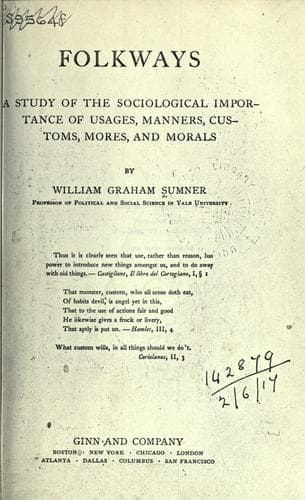
Folkways: A Study of the Sociological Importance of Usages, Manners, Customs, Mores, and Morals — John Shaqi
Folkways: A Study of the Sociological Importance of Usages, Manners, Customs, Mores, and MoralsSumner, William Graham
General
Folkways: A Study of the Sociological Importance of Usages, Manners, Customs, Mores, and Morals
Sumner, William Graham
Manners and customs
+9. Good and bad luck; ills of life; goodness and happiness.+
There are in nature numerous antagonistic forces of growth or
production and destruction. The interests of man are between the
two and may be favored or ruined by either. Correct knowledge of
both is required to get the advantages and escape the injuries.
Until the knowledge becomes adequate the effects which are
encountered appear to be accidents or cases of luck. There is no
thrift in nature. There is rather waste. Human interests require
thrift, selection, and preservation. Capital is the condition
precedent of all gain in security and power, and capital is
produced by selection and thrift. It is threatened by all which
destroys material goods. Capital is therefore the essential means
of man's power over nature, and it implies the purest concept of
the power of intelligence to select and dispose of the processes
of nature for human welfare. All the earliest efforts in this
direction were blundering failures. Men selected things to be
desired and preserved under impulses of vanity and superstition,
and misconceived utility and interest. The errors entered into
the folkways, formed a part of them, and were protected by them.
Error, accident, and luck seem to be the only sense there is in
primitive life. Knowledge alone limits their sway, and at least
changes the range and form of their dominion. Primitive folkways
are marked by improvidence, waste, and carelessness, out of which
prudence, foresight, patience, and perseverance are developed
slowly, by pain and loss, as experience is accumulated, and
knowledge increases also, as better methods seem worth while. The
consequences of error and the effects of luck were always mixed.
As we have seen, the ills of life were connected with the
displeasure of the ghosts. _Per contra_, conduct which conformed
to the will of the ghosts was goodness, and was supposed to bring
blessing and prosperity. Thus a correlation was established, in
the faith of men, between goodness and happiness, and on that
correlation an art of happiness was built. It consisted in a
faithful performance of rites of respect towards superior powers
and in the use of lucky times, places, words, etc., with
avoidance of unlucky ones. All uncivilized men demand and expect
a specific response. Inasmuch as they did not get it, and indeed
the art of happiness always failed of results, the great question
of world philosophy always has been, What is the real relation
between happiness and goodness? It is only within a few
generations that men have found courage to say that there is
none. The whole strength of the notion that they are correlated
is in the opposite experience which proves that no evil thing
brings happiness. The oldest religious literature consists of
formulas of worship and prayer by which devotion and obedience
Public-domain text, read in full here on John Shaqi.
Reviews
Reviews
No reviews yet
Be the first to share your thoughts on this work.
Join the Discussion
Join the discussion
Sign in to leave a comment or review.
Sign InorCreate an account