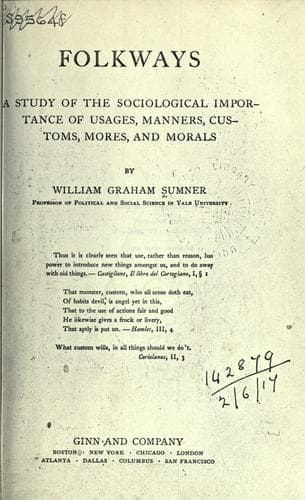
Folkways: A Study of the Sociological Importance of Usages, Manners, Customs, Mores, and Morals — John Shaqi
Folkways: A Study of the Sociological Importance of Usages, Manners, Customs, Mores, and MoralsSumner, William Graham
General
Folkways: A Study of the Sociological Importance of Usages, Manners, Customs, Mores, and Morals
Sumner, William Graham
Manners and customs
were to produce satisfaction of the gods, and win favor and
prosperity for men.[5] The words "ill" and "evil" have never yet
thrown off the ambiguity between wickedness and calamity. The two
ideas come down to us allied or combined. It was the rites which
were the object of tradition, not the ideas which they
embodied.[6]
+10. Illustrations.+ The notions of blessing and curse are
subsequent explanations by men of great cases of prosperity or
calamity which came to their knowledge. Then the myth-building
imagination invented stories of great virtue or guilt to account
for the prosperity or calamity.[7] The Greek notion of the
Nemesis was an inference from observation of good and ill fortune
in life. Great popular interest attached to the stories of
Croesus and Polycrates. The latter, after all his glory and
prosperity, was crucified by the satrap of Lydia. Croesus had
done all that man could do, according to the current religion, to
conciliate the gods and escape ill fortune. He was very pious and
lived by the rules of religion. The story is told in different
forms. "The people could not make up their minds that a prince
who had been so liberal to the gods during his prosperity had
been abandoned by them at the moment when he had the greatest
need of their aid."[8] They said that he expiated the crime of
his ancestor Gyges, who usurped the throne; that is, they found
it necessary to adduce some guilt to account for the facts, and
they introduced the notion of hereditary responsibility. Another
story was that he determined to sacrifice all his wealth to the
gods. He built a funeral pyre of it all and mounted it himself,
but rain extinguished it. The gods were satisfied. Croesus
afterwards enjoyed the friendship of Cyros, which was good
fortune. Still others rejected the doctrines of correlation
between goodness and happiness on account of the fate of
Croesus. In ancient religion "the benefits which were expected
from the gods were of a public character, affecting the whole
community, especially fruitful seasons, increase of flocks and
herds, and success in war. So long as the community flourished,
the fact that an individual was miserable reflected no discredit
on divine providence, but was rather taken to prove that the
sufferer was an evil-doer, justly hateful to the gods."[9] Jehu
and his house were blamed for the blood spilt at Israel, although
Jehu was commissioned by Elisha to destroy the house of Ahab.[10]
This is like the case of OEdipus, who obeyed an oracle, but
suffered for his act as for a crime. Jehovah caused the ruin of
those who had displeased him, by putting false oracles in the
mouths of prophets.[11] Hezekiah expostulated with God because,
although he had walked before God with a perfect heart and had
done what was right in His sight, he suffered calamity.[12] In
Public-domain text, read in full here on John Shaqi.
Reviews
Reviews
No reviews yet
Be the first to share your thoughts on this work.
Join the Discussion
Join the discussion
Sign in to leave a comment or review.
Sign InorCreate an account