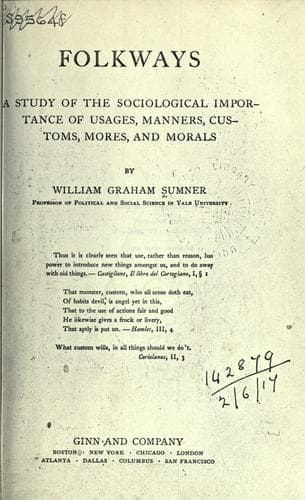
Folkways: A Study of the Sociological Importance of Usages, Manners, Customs, Mores, and MoralsSumner, William Graham
General
Folkways: A Study of the Sociological Importance of Usages, Manners, Customs, Mores, and Morals
Sumner, William Graham
Manners and customs
are but the relics, in combination with the demonstratives, prepares the
outlines of the sentence, and already represents the verb and the names
of states or actions. Imitation, direct or symbolical, and necessarily
only approximative to the sounds of external nature, i. e.
onomatopoeia, furnished the elements of the attributive roots, from
which arose the names of objects, special verbs, and their derivatives.
Analogy and metaphor complete the vocabulary, applying to the objects,
discerned by touch, sight, smell, and taste, qualifying adjectives
derived from onomatopoeia. Reason, then coming into play, rejects the
greater part of this unmanageable wealth, and adopts a certain number of
sounds which have already been reduced to a vague and generic sense, and
by derivation, combination, and affixes, which are the root sounds,
produces those endless families of words, related to each other in every
degree of kindred, from the closest to the most doubtful, which grammar
finally ranges in the categories known as the parts of speech."[254]
"That metaphor makes language grow is evident. It brings about
connection between place, time, and sound ideas."[255]
+138. Primitive dialects.+ The _cebus azarae_, a monkey of Paraguay,
makes six distinct sounds when excited, which causes its comrades to
emit similar sounds.[256] The island Caribs have two distinct
vocabularies, one of which is used by men and by women when speaking to
each other, and by men when repeating, in _oratio obliqua_, some saying
of the women. Their councils of war are held in a secret jargon into
which women are never initiated.[257] The men and women have separate
languages, a custom which is noted also amongst the Guycurus and other
peoples of Brazil.[258] Amongst the Arawaks the difference between the
languages of the sexes is not in regard to the use of words only, but
also in regard to their inflection.[259] The two languages are sometimes
differentiated by a constant change, e.g. where in the man's language
two vowels come together the woman's language intercalates a _k_.[260]
The Arawaks have words which only men may speak, and others which only
women may speak.[261] Dialectical variations are illustrated for us by
facts which come under observation and report. Christian[262] mentions
an American negro castaway, who settled on Raven's Island with a native
wife and children and a few relatives and servants. In forty years they
had produced "a new and peculiar dialect of their own, broadening the
softer vowels and substituting _th_ or _f_ for the original _t_ sound in
the parent ponapeian." Martius mentions that native boatmen in Brazil,
who had grown up together, had each some little peculiarity of
pronunciation. Such a difference would produce a dialect in case of
isolation. On the other hand, the ecclesiastics adopted the Tupi
language and made it a general language for the province of Gram Para,
so that it was used in the pulpit until 1757 and is now necessary for
Public-domain text, read in full here on John Shaqi.
Reviews
Reviews
No reviews yet
Be the first to share your thoughts on this work.
Elsewhere in the archive
Join the Discussion
Join the discussion
Sign in to leave a comment or review.
Sign InorCreate an account