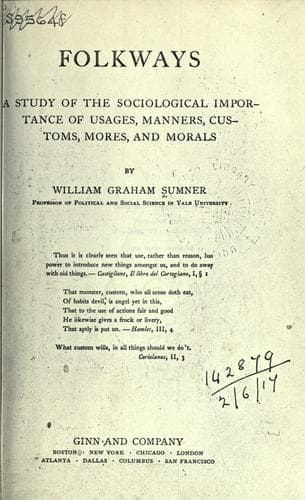
Folkways: A Study of the Sociological Importance of Usages, Manners, Customs, Mores, and MoralsSumner, William Graham
General
Folkways: A Study of the Sociological Importance of Usages, Manners, Customs, Mores, and Morals
Sumner, William Graham
Manners and customs
intercourse in the interior.[263] The Gauchos of central Uruguay speak
Spanish with harsh rough accents. They change _y_ and _ll_ into the
French _j_.[264] Whitney and Waitz thought that all American languages
proceeded from a single original one. Powell thought that they were
"many languages, belonging to distinct families, which have no apparent
unity of origin."[265] Evidence is adduced, however, that "the same
aboriginal peoples who named the waters of North America coined also the
prehistoric geographical titles in South America."[266] The Finns and
Samoyeds are, from the standpoint of language, practically the same
race. The two tongues present the highest development of the
agglutinative process of the Ural-Altaic languages.[267]
+139. Taking up and dropping languages.+ The way in which languages are
taken up or dropped is also perplexing. Keane[268] gives a list of
peoples who have dropped one language and taken up another; he also
gives a list of those who have changed physical type but have retained
the same language. Holub[269] mentions the Makololo, who have almost
entirely disappeared, but their language has passed to their
conquerors. It became necessary to the latter from the spread of their
dominion and from their closer intercourse with the peoples south of the
Zambesi, on account of which, "without any intentional interference by
the rulers, a common and easily understood language showed itself
indispensable." Almost every village in New Guinea has its own language,
and it is said that in New Britain people who live thirty miles apart
cannot understand each other.[270]
+140. Pigeon dialects.+ The Germans find themselves at a disadvantage in
dealing with aborigines because they have no dialect like pigeon English
or the Coast Malay used by the Dutch.[271] Many examples are given, from
the Baltic region, of peasant dialects made in sport by subjecting all
words to the same modification.[272] Our own children often do this to
English in order to make a secret language.
Public-domain text, read in full here on John Shaqi.
Reviews
Reviews
No reviews yet
Be the first to share your thoughts on this work.
Elsewhere in the archive
Join the Discussion
Join the discussion
Sign in to leave a comment or review.
Sign InorCreate an account