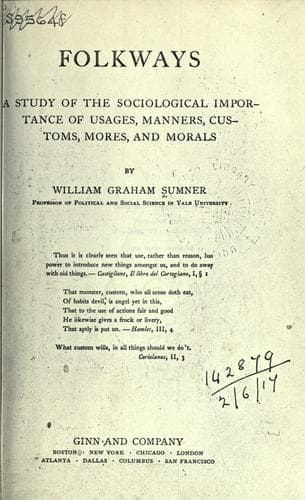
Folkways: A Study of the Sociological Importance of Usages, Manners, Customs, Mores, and MoralsSumner, William Graham
General
Folkways: A Study of the Sociological Importance of Usages, Manners, Customs, Mores, and Morals
Sumner, William Graham
Manners and customs
+141. How languages grow.+ What we see in these cases is that, if we
suppose men to have joined in cooperative effort with only the sounds
used by apes and monkeys, the requirement of their interests would push
them on to develop languages such as we now know. The isolating,
agglutinative, incorporative, and inflectional languages can be put in a
series according to the convenience and correctness of the logical
processes which they embody and teach. The Semitic languages evidently
teach a logic different from that of the Indo-European. It is a
different way of thinking which is inculcated in each great family of
languages. They represent stages in the evolution of thought or ways of
thinking. The instance is one of those which best show us how folkways
are built up and how they are pulled down. The agglutination of words
and forms sometimes seems like a steady building process; again, the
process will not go forward at all. "In the agglutinative languages
speech is berry jam. In the inflectional languages each word is like a
soldier in his place with his outfit."[273] The "gooing" of a baby is a
case of the poetic power in its blossoming exuberance. The accidental
errors of pronunciation which are due to very slight individual
variations in the form of the vocal organs are cases of individual
contribution to the development of language. The baby words and
individual mispronunciations which are taken up by a family and its
friends, but never get further, show us how dialects grow. There are
changes in language which are, "in their inception, inaccuracies of
speech. They attest the influence of that immense numerical majority
among the speakers of English who do not take sufficient pains to speak
correctly, but whose blunders become finally the norm of the
language."[274] In analogy things which are alike are embraced in a
single term; in metaphor two or more things which seem alike, but may
not be so, are grouped together and are embraced in a single term. All
these modes of change in language attest the work of individuals on
language. Sometimes there is extension of influence to a group.
Sometimes the influence is only temporary and is rejected again.
Sometimes it falls in with a drift of taste or habit, when it is taken
up and colors the pronunciation or usage of the population of a great
district, and becomes fixed in the language. All this is true also on
the negative side, since usage of words, accent, timbre of the voice,
and pronunciation (drawling, nasal tones) expel older usages. Language
therefore illustrates well all the great changes of folkways under the
heads of cooperation and antagonism. We have an excellent chance to
study the operation in the case of slang. A people who are prosperous
and happy, optimistic and progressive, will produce much slang. It is a
case of play. They amuse themselves with the language. We may think the
new words and phrases vulgar and in bad taste, or senseless and
ridiculous.
Public-domain text, read in full here on John Shaqi.
Reviews
Reviews
No reviews yet
Be the first to share your thoughts on this work.
Elsewhere in the archive
Join the Discussion
Join the discussion
Sign in to leave a comment or review.
Sign InorCreate an account