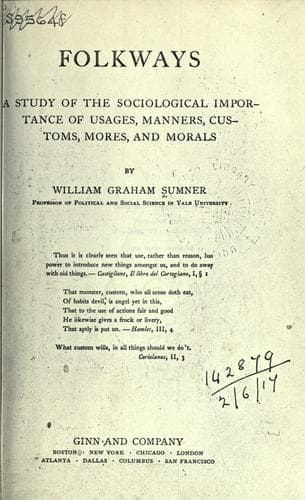
Folkways: A Study of the Sociological Importance of Usages, Manners, Customs, Mores, and MoralsSumner, William Graham
General
Folkways: A Study of the Sociological Importance of Usages, Manners, Customs, Mores, and Morals
Sumner, William Graham
Manners and customs
We may reject them, but the masses will decide whether they
shall be permanently rejected or not. The vote is informal. The most
confirmed purist will by and by utter a new slang word when he needs it.
One's objections are broken down. One's taste is spoiled by what he
hears. We are right in the midst of the operation of making folkways and
can perceive it close at hand.
+142. Money.+ Money is another primitive device which is produced in
the folkways. Money was not called into existence by any need
universally experienced and which all tried to satisfy as well as they
could. It was produced by developing other devices, due to other
motives, until money was reached as a result. Property can be traced to
portable objects which were amulets, trophies, and ornaments all at
once. These could be accumulated, and if they were thought to be the
abodes of powerful spirits, they were gifts which were eagerly sought,
or valuable objects for exchange. They led to hoarding (since the owner
did not like to part with them), and they served as marks of personal
distinction.[275] The interplay of vanity and religion with the love of
property demands attention. Religion also caused the aborigines of the
northwest provinces of South America to go to the rivers for gold only
in sufficient amount to buy what they needed. Any surplus they returned
to the stream. "They say that if they borrow more than they really need
the river-god will not lend them any more."[276] In later times and
higher civilization coins have been used as amulets to ward off or to
cure disease.[277] The Greenland Eskimo laughed when they were offered
gold and silver coins. They wanted objects of steel, for which they
would give anything which they had and which was desired.[278] The
Tarahumari of Sonora do not care for silver money. Their Croesus
raises three hundred or four hundred bushels of corn per annum. The
largest herd of cattle contains thirty or forty head. They generally
prefer cotton cloth to dollars.[279] "A Dyak has no conception of the
use of a circulating medium. He may be seen wandering in the Bazaar with
a ball of bee's wax in his hand for days together, because he cannot
find anybody willing to take it for the exact article which he
requires."[280] We meet with a case in which people have gold but live
on a system of barter. It is a people in Laos, north of Siam. They weigh
gold alone in scales against seeds of grain.[281] In the British Museum
(Case F, Ireland) may be seen bronze rings, to be sewn on garments as
armor or to be used as money, or both. The people along the west coast
of Hindostan, from the Persian Gulf to Ceylon, used as money the
fishhook which was their most important tool. It became degraded into a
piece of doubled wire of silver or bronze. If the degradation had gone
on, doubtless it would have resulted in a lump of metal, just as the
Siamese silver coins are the result of doubling up silver rings.[282]
Public-domain text, read in full here on John Shaqi.
Reviews
Reviews
No reviews yet
Be the first to share your thoughts on this work.
Elsewhere in the archive
Join the Discussion
Join the discussion
Sign in to leave a comment or review.
Sign InorCreate an account