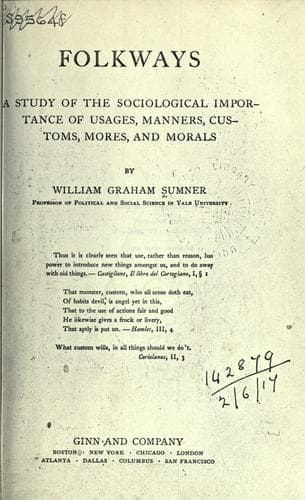
Folkways: A Study of the Sociological Importance of Usages, Manners, Customs, Mores, and MoralsSumner, William Graham
General
Folkways: A Study of the Sociological Importance of Usages, Manners, Customs, Mores, and Morals
Sumner, William Graham
Manners and customs
The play of custom and convention is well shown by the use of the
Macedonian coins in England. The coins of Philip bore on the obverse a
head with a wreath, and on the reverse a chariot driver drawn by two
horses. In Britain this coin became a sign of value and lost its
reference to the sovereign. It is possible to show the order of the
reigns of the kings by the successive omissions of parts of the figures,
until only the wreath was left and four perpendicular strokes and two
circles for the legs of one horse and two chariot wheels. Each change
was a mark of value and then it was further changed to save
trouble.[283] On the Palau Islands there were seven grades of money,
determined by the size. Only three or four pieces exist of the first
grade. The second grade is of jasper. The third consists of agate
cylinders. These three grades are used only by nobles. They have the
same rank as gems amongst us. The people think of the money as coming
from an island where it lives a divine life, the lower ranks serving the
upper. They have myths of the coming of the money to Palau.[284] These
examples show to what a great extent other ideas than those of value
come into play in money.
+143. Intergroup and intragroup money.+ When money is used to overcome
the difficulties of barter two cases are to be distinguished,--the
intergroup and the intragroup uses, which are primarily distinguished by
a space relation. The intragroup use is here, in the we-group, close at
hand. The intergroup use is between our group and some out-group. It
will be found that all money problems include these two cases. "At least
we shall find that the current commonplace of the economists about the
succession of natural economy, money economy, and credit economy, is not
even remotely apt to the real problems."[285] What is true is that, on a
money economy, it is found that there is, or may be, a constant exchange
of money for goods and goods for money, from which gain or loss may
result; and furthermore that the risk (aleatory element) in this
exchange is intensified, if time is allowed to intervene. Inside the
we-group the first need for money is for fees, fines, amercements, and
bride price. In Melanesia pigs are not called money and there is shell,
feather, and mat money, but pigs are paid for fines, penalties,
contributions to feasts, fees in the secret society, pay for wives, and
in other societal relations. What is needed is a mobile form of wealth,
with which social dues can be paid. This is the function of money which
the paper-money projectors have in mind when they propose to issue paper
which the state shall take for taxes. It is evident that it is to be
distinguished from the economic function of money as a circulating
medium. The intragroup money needs to be especially a measure and store
of value, while the intergroup money needs to be a medium of exchange.
In the former case barter is easy; in the latter case it is regular. In
Public-domain text, read in full here on John Shaqi.
Reviews
Reviews
No reviews yet
Be the first to share your thoughts on this work.
Elsewhere in the archive
Join the Discussion
Join the discussion
Sign in to leave a comment or review.
Sign InorCreate an account