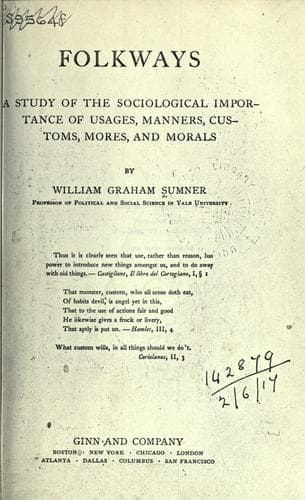
Folkways: A Study of the Sociological Importance of Usages, Manners, Customs, Mores, and MoralsSumner, William Graham
General
Folkways: A Study of the Sociological Importance of Usages, Manners, Customs, Mores, and Morals
Sumner, William Graham
Manners and customs
+164. Chances of acquiring wealth in modern times; effect on modern
mores; speculation involved in any change.+ The effect of the opening of
new continents, the application of new inventions, and the expansion of
commerce has been to make it easy for men with suitable talent to
increase wealth. These changes have cheapened all luxuries, that is,
have reduced them to common necessities. They have made land easily
accessible to all, even the poorest, in the new countries, while
lowering rent in old countries. They have raised wages and raised the
standard of living and comfort. They have lessened the competition of
life throughout civilized nations, and have made the struggle for
existence far less severe. It is the changes in life conditions which
have made slavery impossible and extended humanitarian sympathy. They
have lessened social differentiation (that is, they have democratized),
and they have intensified the industrial organization. In detail, and
for individuals, this has often caused hardship. For the petty
professional and semiprofessional classes it has been made harder to
keep up the externals of a certain social position. For those classes
the standard of living has risen faster than steam has cheapened
luxuries. Discontent, anxiety, care for appearances, desire to impose by
display, envy, and mean social ambition characterize the mores, together
with energy and enterprise. Envy and discontent are amongst the very
strongest traits of modern society. Very often they are only
manifestations of irritated vanity. It is in the nature of things that
classes of men and forms of property shall go through endless
vicissitudes of advantage and disadvantage. Nobody can foresee these and
speculate upon them with success. When it is proposed to "reorganize
society" on any socialistic theory, or on no theory, it should be
noticed that such an enterprise involves a blind speculation on the
vicissitudes of classes and forms of property in the future. "Wealth,
whether in land or money, has been increased by marriages and
inheritances, reduced to fragments by divisions, even in noble families
[in spite of settlements and entails], dissipated by prodigals,
reconstituted by men of economical habits, centupled by industrious and
competent men of enterprise, scattered by the indolent, the unfortunate,
and the men of bad judgment, who have risked it unwisely. Political
events have affected it as well as the favor of princes, advantageous
offices in the state, popular revolts, wars, confiscations, from the
abolition of serfdom in the fourteenth century until the abolition, in
1790, of the dues known as feudal, although they were, for the most
part, owned by members of the bourgeoisie."[369] So it will be in the
future, in spite of all that men can do. If two men had the same sum of
money in 1200, and one bought land while the other became a money
lender, anywhere in western Europe, the former would to-day be more or
Public-domain text, read in full here on John Shaqi.
Reviews
Reviews
No reviews yet
Be the first to share your thoughts on this work.
Elsewhere in the archive
Join the Discussion
Join the discussion
Sign in to leave a comment or review.
Sign InorCreate an account