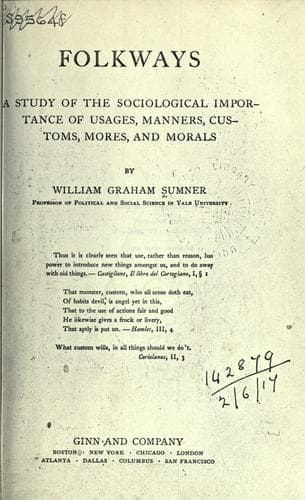
Folkways: A Study of the Sociological Importance of Usages, Manners, Customs, Mores, and MoralsSumner, William Graham
General
Folkways: A Study of the Sociological Importance of Usages, Manners, Customs, Mores, and Morals
Sumner, William Graham
Manners and customs
less rich according to the position of his land. He might be a great
millionaire. The other would have scarcely anything left.[370] Shall we
then all buy land now? Let those do so who can foresee the course of
values in the next seven hundred years. The popular notion is that
nobles have always owned land. The truth is that men who have acquired
wealth have bought land and got themselves ennobled. In France, "in the
seventeenth and eighteenth centuries, nineteen twentieths of those who
were called nobles were middle-class men enriched, decorated, and
possessed of land."[371] The middle class in western Europe has been
formed out of the labor class within seven hundred years. The whole
middle class, therefore, represents the successful rise of the serfs,
but, since a labor class still remains, it is asserted that there has
been no change. On the other hand, there has been a movement of nobles
and middle-class grandees downward into the labor class and the
proletariat. It was said, a few years ago, that a Plantagenet was a
butcher in a suburb of London. It is also asserted that representatives
of great mediaeval families are now to be found as small farmers, farm
laborers, or tramps in modern England.[372]
+165. Mores conform to changes in life conditions; great principles;
their value and fate.+ For our purpose it suffices here to notice how
the mores have followed the changes in life conditions, how they have
reacted on the current faiths and philosophies, and how they have
produced ethical notions to justify the mores themselves. They have
produced notions of natural rights and of political philosophy to
support the new institutions. There are thousands in the United States
who believe that every adult male has a natural right to vote, and that
the vote makes the citizen. The doctrine of natural rights has received
some judicial recognition, and it has been more or less accepted and
applied in the constitutions of various states which were established in
the nineteenth century. The American doctrines of 1776 and the French
doctrines of 1789 are carried on and used in stump oratory until they
get in the way of some new popular purpose, but what produced both was
the fact that some new classes had won wealth and economic power and
they wanted political recognition. To get it they had to invent some new
"great principles" to justify their revolt against tradition. That is
the way in which all "great principles" are produced. They are always
made for an exigency. Their usefulness passes with the occasion. The
mores are forever adjusting efforts to circumstances. Sooner or later
they need new great principles. Then they obliterate the old ones. The
old jingle of words no longer wins a response. The doctrine is dead. In
1776 it seemed to every Whig in America that it was a pure axiom to say
that governments derive their just powers from the consent of the
governed. They clung to this as a sacred dogma for over a hundred years,
Public-domain text, read in full here on John Shaqi.
Reviews
Reviews
No reviews yet
Be the first to share your thoughts on this work.
Elsewhere in the archive
Join the Discussion
Join the discussion
Sign in to leave a comment or review.
Sign InorCreate an account