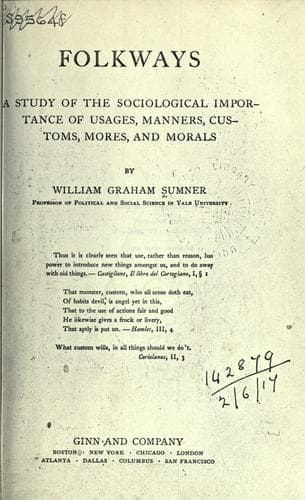
Folkways: A Study of the Sociological Importance of Usages, Manners, Customs, Mores, and MoralsSumner, William Graham
General
Folkways: A Study of the Sociological Importance of Usages, Manners, Customs, Mores, and Morals
Sumner, William Graham
Manners and customs
because it did not affect unfavorably any interest. It is untrue.
Governments get their powers from the historical fact of their
existence. They are all ephemeral, subject to change. When a change
takes place it is controlled by the ideas and interests of the time of
change, when the popular element in self-government may be much greater
than when the constitution was last previously established. In 1898 the
popular will, in the United States, was to take possession of the
Philippine Islands and to become rulers there, not ruled, as the fathers
were in the colonies of 1776. The great doctrine of the source of due
power was quickly trampled under foot. The same fate awaits all the rest
of the "great principles." The doctrine that all men are equal is being
gradually dropped, from its inherent absurdity, and we may at any time
find it expedient to drop the jingle about a government of the people,
by the people, and for the people. It was only good historically to
destroy the doctrine, "Everything for the people; nothing by them."
+166. The French Revolution.+ The French Revolution was due to the fact
that a great change had come about in the distribution of economic power
between classes and in the class mores which correspond to economic
power. All the political institutions of a modern state are conservative
in the sense that they retain and sustain what is and has been, and
resist interference or change. The historical picture is often such that
abuses are maintained and reform seems hopeless, on account of the power
of existing institutions and customs and the depth of convictions of
social welfare which have become traditional. The student of the history
is led to believe that any reform or revolution, as a dissolution of the
inherited system of repression and retention, is worth all that it may
cost. Hence some students of history become believers in "revolution" as
a beneficent social force or engine. In the case of the French
Revolution, the passions which were set loose destroyed the whole social
order, swept away all the institutions, and even destroyed all the
inherited mores. It is evident that this last is what the revolutionists
finally aimed at. The _ancien regime_ came to mean the whole fabric of
the old society, with its codes, standards, and ideas of right, wrong,
the desirable, etc. The revolutionists also undertook to invent new
mores, that is, new codes and standards, new conceptions of things
socially desirable, a new religion, and new notions of civil duty and
responsibility. During the Directory and the Consulate there was a gulf
between the ancient and the new in which there was anarchy of the mores,
even after the civil machinery was repaired and set in operation again.
Napoleon brought back institutions and forms of social order so far as
seemed desirable for his own interest. The historical continuity was
broken and has remained so. Of the _ancien regime_ there can be found
to-day only ruins and relics.
Public-domain text, read in full here on John Shaqi.
Reviews
Reviews
No reviews yet
Be the first to share your thoughts on this work.
Elsewhere in the archive
Join the Discussion
Join the discussion
Sign in to leave a comment or review.
Sign InorCreate an account