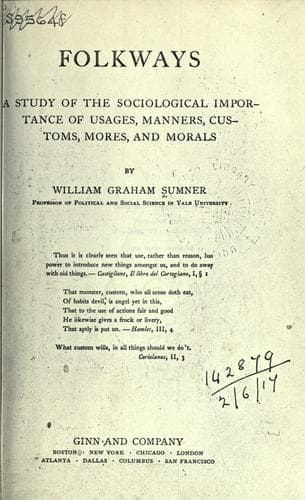
Folkways: A Study of the Sociological Importance of Usages, Manners, Customs, Mores, and MoralsSumner, William Graham
General
Folkways: A Study of the Sociological Importance of Usages, Manners, Customs, Mores, and Morals
Sumner, William Graham
Manners and customs
Nevertheless, the ancient mores of social
faith and morality, of social well living, of religious duty and family
virtue, are substantially what they were before the great explosion.
This is the last and greatest lesson of the revolution: it is impossible
to abolish the mores and to replace them by new ones rationally
invented. To change a monarchy into a republic is trifling. Individuals
and classes can be guillotined. Institutions can be overturned. Religion
can be abolished or put out of fashion. The mores are in the habits of
the people, and are needed and practiced every day. The revolutionists
ordered changes in the social ritual, and they brought about a disuse of
"monsieur" and "madame." All their innovations in the ritual have fallen
into disuse, and the old fashions have returned, in obedience to common
sense. The new classes have not enjoyed their victory over the old as to
courtesy, social comity, and civil good-fellowship. They have abandoned
it, and have recognized the fact that the old aristocracy had well
solved all matters of this kind. As wealth has increased and artisans
and peasants have gained new powers of production and acquisition, they
have learned to laugh at the civil philosophy and enthusiasm of the
eighteenth-century philosophers, and have ordered their lives, as far as
possible or convenient, on the old aristocratic models. Sansculottism
is inconsistent with respect for productive labor, or with the
accumulation of wealth. No one who can earn great wages or who possesses
wealth will, out of zeal for philosophical doctrines, prefer to live in
squalor and want. The relation of modern mores to new feelings in
respect to labor and trade, and to the accumulation of wealth, are to be
easily perceived from the course of modern revolutions.
Public-domain text, read in full here on John Shaqi.
Reviews
Reviews
No reviews yet
Be the first to share your thoughts on this work.
Elsewhere in the archive
Join the Discussion
Join the discussion
Sign in to leave a comment or review.
Sign InorCreate an account