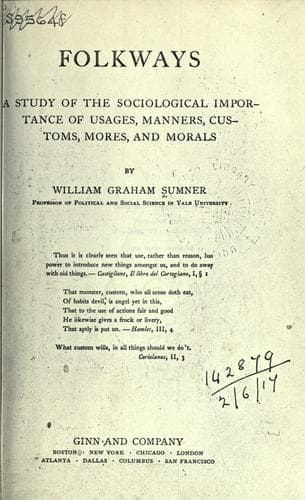
Folkways: A Study of the Sociological Importance of Usages, Manners, Customs, Mores, and MoralsSumner, William Graham
General
Folkways: A Study of the Sociological Importance of Usages, Manners, Customs, Mores, and Morals
Sumner, William Graham
Manners and customs
+167. Ruling classes.+ +Special privileges.+ +Corruption of the mores.+
In every societal system or order there must be a ruling class or
classes; in other words, a class gets control of any society and
determines its political form or system. The ruling class, therefore,
has the power. Will it not use the power to divert social effort to its
own service and gain? It must be expected to do so, unless it is checked
by institutions which call into action opposing interests and forces.
There is no class which can be trusted to rule society with due justice
to all, not abusing its power for its own interest. The task of
constitutional government is to devise institutions which shall come
into play at the critical periods to prevent the abusive control of the
powers of a state by the controlling classes in it. The ruling classes
in mediaeval society were warriors and ecclesiastics, and they used all
their power to aggrandize themselves at the expense of other classes.
Modern society is ruled by the middle class. In honor of the bourgeoisie
it must be said that they have invented institutions of civil liberty
which secure to all safety of person and property. They have not,
therefore, made a state for themselves alone or chiefly, and their state
is the only one in which no class has had to fear oppressive use of
political power. The history of the nineteenth century, however, plainly
showed the power of capital in the modern state. Special legislation,
charters, and franchises proved to be easy legislative means of using
the powers of the state for the pecuniary benefit of the few. In the
first half of the century, in the United States, banks of issue were
used to an extravagant pitch for private interest. The history is
disgraceful, and it is a permanent degradation of popular government
that power could not be found, or did not exist, in the system to
subjugate this abuse and repress this corruption of state power. The
protective-tariff system is simply an elaborate system by which certain
interests inside of a country get control of legislation in order to tax
their fellow-citizens for their own benefit. Some of the victims claim
to be taken "into the steal," and if they can make enough trouble for
the clique in power, they can force their own admission. That only
teaches all that the great way to succeed in the pursuit of wealth is to
organize a steal of some kind and get inside of it. The pension system
in the United States is an abuse which has escaped from control. There
is no longer any attempt to cope with it. It is the share of the "common
man" in the great system of public plunder. "Graft" is only a proof of
the wide extent to which this lesson to get into the steal is learned.
It only shows that the corrupt use of legislation and political power
has affected the mores. Every one must have his little sphere of plunder
and especial advantage. This conviction and taste becomes so current
that it affects all new legislation.
Public-domain text, read in full here on John Shaqi.
Reviews
Reviews
No reviews yet
Be the first to share your thoughts on this work.
Elsewhere in the archive
Join the Discussion
Join the discussion
Sign in to leave a comment or review.
Sign InorCreate an account