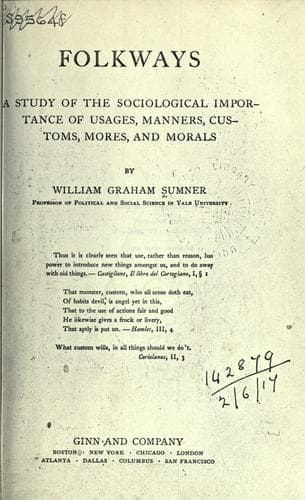
Folkways: A Study of the Sociological Importance of Usages, Manners, Customs, Mores, and MoralsSumner, William Graham
General
Folkways: A Study of the Sociological Importance of Usages, Manners, Customs, Mores, and Morals
Sumner, William Graham
Manners and customs
The legislators do not doubt that
it is reasonable and right to enact laws which provide favor for special
interests, or to practice legislative strikes on insurance companies,
railroads, telephone companies, etc. They laugh at remonstrance as out
of date and "unpractical." The administrators of life-insurance
companies, savings banks, trusts, etc., proceed on the belief that men
in positions of power and control will use their positions for their own
advantage. They think that that is only common sense. "What else are we
here for?" It is the supreme test of a system of government whether its
machinery is adequate for repressing the selfish undertakings of cliques
formed on special interests and saving the public from raids of
plunderers. The modern democratic states fail under this test. There is
not a great state in the world which was not democratized in the
nineteenth century. There is not one of them which did not have great
financial scandals before the century closed. Financial scandal is the
curse of all the modern parliamentary states with a wide suffrage. They
give liberty and security, with open chances for individual enterprise,
from which results great individual satisfaction and happiness, but the
political machinery offers opportunities for manipulation and corrupt
abuse. They educate their citizens to seek advantages in the industrial
organization by legislative devices, and to use them to the uttermost.
The effect is seen in the mores. We hear of plutocracy and tainted
money, of the power of wealth, and the wickedness of corporations. The
disease is less specific. It is constitutional. The critics are as
subject to it as the criticised. A disease of the mores is a disease of
public opinion as to standards, codes, ideas of truth and right, and of
things worth working for and means of success. Such a disease affects
everybody. It penetrates and spoils every institution. It spreads from
generation to generation, and at last it destroys in the masses the
power of ethical judgment.
Public-domain text, read in full here on John Shaqi.
Reviews
Reviews
No reviews yet
Be the first to share your thoughts on this work.
Elsewhere in the archive
Join the Discussion
Join the discussion
Sign in to leave a comment or review.
Sign InorCreate an account