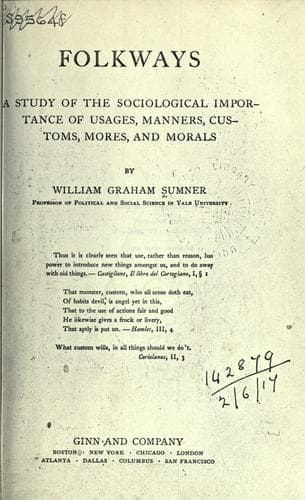
Folkways: A Study of the Sociological Importance of Usages, Manners, Customs, Mores, and MoralsSumner, William Graham
General
Folkways: A Study of the Sociological Importance of Usages, Manners, Customs, Mores, and Morals
Sumner, William Graham
Manners and customs
and overwhelm people who are not trained to verify assertions and
dissect fallacies.
+174. Watchwords, catchwords.+ A watchword sums up one policy,
doctrine, view, or phase of a subject. It may be legitimate and useful,
but a watchword easily changes its meaning and takes up foreign
connotations or fallacious suggestions. Critical analysis is required to
detect and exclude the fallacy. Catchwords are acutely adapted to
stimulate desires. In the presidential campaign of 1900 we saw a
catchword deliberately invented,--"the full dinner pail." Such an
invention turns suggestion into an art. Socialism, as a subject of
popular agitation, consists almost altogether of watchwords, catchwords,
and phrases of suggestion: "the boon of nature," "the banquet of life,"
"the disinherited," "the submerged tenth," "the mine to the miner,"
"restore the land to the landless." Trades unionism consists almost
entirely, on its philosophical side, of suggestive watchwords and
phrases. It is said that "labor" creates all value. This is not true,
but the fallacy is complete when labor is taken in the sense of
"laborers," collectively and technically so called,--an abuse of
language which is now current. To say that wage-earners create all value
is to assert a proposition from which numerous and weighty consequences
follow as to rights and interests. "The interest of one is the interest
of all" is a principle which is as good for a band of robbers as for a
union of any other kind. "Making work" by not producing is the greatest
industrial fallacy possible.
+175. Slave, democracy.+ Since "democratic" is now a word to conjure
with, we hear of democracy in industry, banking, education, science,
etc., where the word is destitute of meaning or is fallacious. It is
used to prejudice the discussion. Since the abolition of slavery the
word "slave" has become a token. In current discussions we hear of "rent
slaves," "wages slavery," "debt slavery," "marriage slavery," etc. These
words bear witness to great confusion and error in the popular notions
of what freedom is and can be. For negroes emancipation contained a
great disillusion. They had to learn what being "free" did not mean.
Debt slavery is the oldest kind of slavery except war captivity. A man
in debt is not free. A man who has made a contract is not free. A man
who has contracted duties and obligations as husband and father, or has
been born into them as citizen, son, brother, etc., is not free. Can we
imagine ourselves "free" from the conditions of human life? Does it do
any good to stigmatize the case as "wages slavery," when what it means
is that a man is under a necessity to earn his living? It would be a
grand reform in the mores if the masses should learn to turn away in
contempt from all this rhetoric.
Public-domain text, read in full here on John Shaqi.
Reviews
Reviews
No reviews yet
Be the first to share your thoughts on this work.
Elsewhere in the archive
Join the Discussion
Join the discussion
Sign in to leave a comment or review.
Sign InorCreate an account