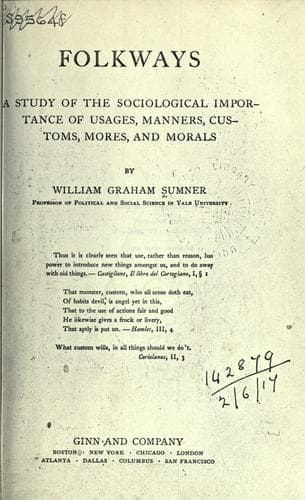
Folkways: A Study of the Sociological Importance of Usages, Manners, Customs, Mores, and MoralsSumner, William Graham
General
Folkways: A Study of the Sociological Importance of Usages, Manners, Customs, Mores, and Morals
Sumner, William Graham
Manners and customs
+176. Epithets.+ Works of fiction have furnished the language with
epithets for types of individuals (sec. 622). Don Quixote, Faust, Punch,
Reinecke Fuchs, Br'er Rabbit, Falstaff, Bottom, and many from Dickens
(Pickwick, Pecksniff, Podsnap, Turveydrop, Uriah Heep) are examples. The
words are like coins. They condense ideas and produce classes. They
economize language. They also produce summary criticisms and definition
of types by societal selection. All the reading classes get the use of
common epithets, and the usage passes to other classes in time. The
coercion of an epithet of contempt or disapproval is something which it
requires great moral courage to endure.
+177. Phrases.+ The educated classes are victims of the phrase. Phrases
are rhetorical flourishes adapted to the pet notions of the time. They
are artifices of suggestion. They are the same old tricks of the
medicine man adapted to an age of literature and common schools. Instead
of a rattle or a drum the operator talks about "destiny" and "duty," or
molds into easy phrases the sentiments which are popular. It is only a
difference of method. Solemnity, unction, and rhetorical skill are
needed. Often the phrases embody only visionary generalities.
"Citizenship," "publicity," "public policy," "restraint of trade," "he
who holds the sea will hold the land," "trade follows the flag," "the
dollar of the fathers," "the key of the Pacific," "peace with honor,"
are some of the recent coinages or recoinages. Phrases have great power
when they are antithetical or alliterative. Some opponents of the silver
proposition were quite perplexed by the saying: "The white man with the
yellow metal is beaten by the yellow man with the white metal." In 1844
the alliterative watchword "Fifty-four forty or fight" nearly provoked a
war. If it had been "Forty-nine thirty or fight," that would not have
had nearly so great effect. The "Cape to Cairo" railroad is another case
of alliteration. Humanitarianism has permeated our mores and has been a
fountain of phrases. Forty years ago the phrase "enthusiasm of humanity"
was invented. It inspired a school of sentimental philosophizing about
social relations, which has been carried on by phrase making: "the
dignity of labor," "the nobility of humanity," "a man is not a ware,"
"an existence worthy of humanity," "a living wage." "Humanity" in modern
languages is generally used in two senses: (_a_) the human race, (_b_)
the sympathetic sentiment between man and man. This ambiguity enters
into all the phrases which are humanitarian.
Public-domain text, read in full here on John Shaqi.
Reviews
Reviews
No reviews yet
Be the first to share your thoughts on this work.
Elsewhere in the archive
Join the Discussion
Join the discussion
Sign in to leave a comment or review.
Sign InorCreate an account