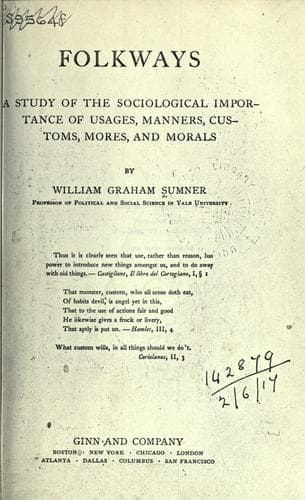
Folkways: A Study of the Sociological Importance of Usages, Manners, Customs, Mores, and MoralsSumner, William Graham
General
Folkways: A Study of the Sociological Importance of Usages, Manners, Customs, Mores, and Morals
Sumner, William Graham
Manners and customs
+190. Fashion in other things than dress.+ As will appear below, fashion
controls many things besides dress. It governs the forms of utensils,
weapons, canoes and boats, tools, etc., amongst savages. In the
fifteenth and sixteenth centuries there was a fashionable attitude or
pose in standing for women, in which the abdomen was thrown forward. It
is often seen in pictures and portraits.[403] It is inelegant and
destitute of meaning. The Venetians were luxurious and frivolous,
jealous and distrustful of women, and fond of pleasure and fashion. From
the end of the sixteenth century a shopkeeper in the Merceria adopted a
custom of showing the new fashions of Paris on Ascension Day by means of
a life-size doll dressed in them.[404] The Venetian women of that period
wore patins, shoes with blocks underneath, some of which were two feet
high. The women were unable to walk without a maid on each side to
support them.[405] Yriarte thinks that these patins were due to the
policy of the husbands. When an ambassador, in conversation with the
doge and his counselors, said that shoes would be far more convenient, a
counselor replied, "Only too convenient! Only too much so!" Under the
French Directory, a _demi-terme_ was the name of a framework worn by
women to look as if they would soon be mothers.[406] Thirty years ago
"poufs" were worn to enlarge the dress on the hips at the side. The
"Grecian bend," stooping forward, was an attitude both in walking and
standing. Then followed the bustle. Later, the contour was closely
fitted by the dress. No one thought that the human figure would be
improved if changed as the dress made it appear to be. No fashion was
adopted because it would have an indecent effect. The point for our
purpose is that women wore dresses of the appointed shape because
everybody did so, and for no other reason, being unconscious of the
effect.
Erasmus, in his colloquy on the Franciscans, makes one of the characters
say: "I think that the whole matter of dress depends upon custom and the
opinions which are current." He refers to some unnamed place where
adulterers, after conviction, are never allowed to uncover the private
parts, and says, "Custom has made it, for them, the greatest of all
punishments." "The fact is that nothing is so ridiculous that usage may
not make it pass."
Public-domain text, read in full here on John Shaqi.
Reviews
Reviews
No reviews yet
Be the first to share your thoughts on this work.
Elsewhere in the archive
Join the Discussion
Join the discussion
Sign in to leave a comment or review.
Sign InorCreate an account