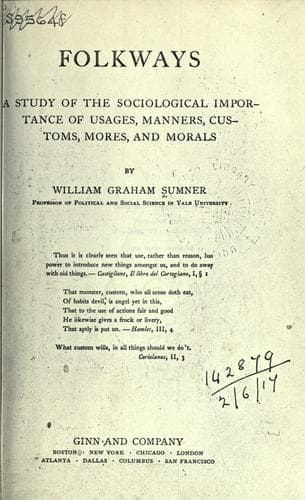
Folkways: A Study of the Sociological Importance of Usages, Manners, Customs, Mores, and MoralsSumner, William Graham
General
Folkways: A Study of the Sociological Importance of Usages, Manners, Customs, Mores, and Morals
Sumner, William Graham
Manners and customs
Fashion has controlled the mode of dressing the hair and deforming the
body. It has determined what animals, or what special race of an animal
species, should be petted. It controls music and literature, so that a
composer, poet, or novelist is the rage or is forgotten. In mediaeval
literature the modes of allegory were highly esteemed and very commonly
used. The writers described war and battles over and over again, and
paid little attention to nature. In fact, natural background, geography,
and meteorology were made as conventional as stage scenery, and were
treated as of no interest and little importance. Modern taste for
reality and for the natural details throws this mediaeval characteristic
by contrast into strong relief.
+191. Miscellaneous fashions.+ Fashion rules in architecture. In the
seventeenth and eighteenth centuries in England, English Renaissance and
Gothic were regarded as barbaric, and palladian was admired. In France
the preference was for rococo and Mansard forms. At the present time the
English Renaissance and Gothic are in favor again, and palladian is
regarded with disfavor. Painting and sculpture undergo variations of
fashion as to standards and methods. The same is true of literature.
Poetry and novels follow phases of fashion. A successful novel makes
imitations and sets a fashion for a time. Types of heroes and ideals of
character come and go by fashion. The type of the man-as-he-should-be
varies by fashion, and this type exerts a great selection in the
education of the young. Educational methods run through fashions. Fads
in methods of teaching arise, are advocated with great emphasis, have
their run, decline, and disappear. There are fashions of standing,
walking, sitting, gesture, language (slang, expletives), pronunciation,
key of the voice, inflection, and sentence accent; fashions in shaking
hands, dancing, eating and drinking, showing respect, visiting, foods,
hours of meals, and deportment. When snuff was taken attitudes and
gestures in taking it were cultivated which were thought stylish.
Fashion determines what type of female beauty is at a time
preferred,--plump or _svelte_, blond or brunette, large or petite,
red-haired or black-haired. When was that "simple time of our fathers"
when people were too sensible to care for fashions? It certainly was
before the Pharaohs and perhaps before the glacial epoch. Isaiah (iii.
16) rebukes the follies of fashion. Chrysostom preached to the early
church against tricks and manners of gesture and walk which had been
learned in the theater. Since literature has existed moralists have
satirized fashion. Galton has noticed what any one may verify,--that old
portraits show "indisputable signs of one predominant type of face
supplanting another." "If we may believe caricaturists, the fleshiness
and obesity of many English men and women in the earlier years of this
century [nineteenth] must have been prodigious."[407] Part of this
Public-domain text, read in full here on John Shaqi.
Reviews
Reviews
No reviews yet
Be the first to share your thoughts on this work.
Elsewhere in the archive