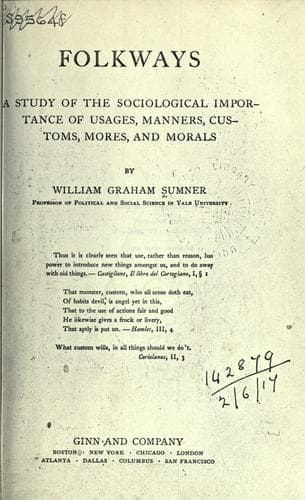
Folkways: A Study of the Sociological Importance of Usages, Manners, Customs, Mores, and MoralsSumner, William Graham
General
Folkways: A Study of the Sociological Importance of Usages, Manners, Customs, Mores, and Morals
Sumner, William Graham
Manners and customs
phenomenon may be due to the fashion of painting. The portrait painter
warps all his subjects toward the current standard of "good looks," but
it is more probable that there is a true play of variation.
Platycnemism and the pierced olecranon run in groups for a time. Then
they run out. There are fashions in disease, as if fashion were really
in nature. This goes beyond the limits of our definition, but the rise
and passing away of variations in breeding plants and animals, and
perhaps in men, suggests that fashion may be an analogous play of
experiment, half caprice, half earnest, whose utility lies in selection.
If there was no reaching out after novelty except upon rational
determination, the case would be very different from what it is when
variation brings spontaneous suggestions. Our present modes of dress
(aside from the variations imposed by fashion) are the resultant of all
the fashions of the last two thousand years.
+192. All deformations by fashion are irrational.+ There is no guarantee
that fashions will serve expediency. Deformations of the skull may not
be harmful; they are not useful. The block inserted in the lip
interferes with eating and speaking. It alters the language. Saliva
cannot be retained, and flows over it. To those who are outside the
fashion it is extremely ugly and disgusting. To those inside the fashion
it is a standard of beauty and a badge of dignity and tribal position.
All fashions tend to extravagance because the senses become accustomed
to them, and it is necessary, in order to renew the impression of
distinction, to exaggerate. The extravagances of fashion run through all
grades of civilization. They show that fashion, coming from the whole to
the individual, adds nothing to the sense, judgment, or taste of the
latter, but imposes on him a coercion to conform. He who dissents is
thought rustic and boorish. He is more or less severely boycotted, which
means not only that he is made to suffer, but that he loses important
advantages and hurts his interests.
Public-domain text, read in full here on John Shaqi.
Reviews
Reviews
No reviews yet
Be the first to share your thoughts on this work.
Elsewhere in the archive
Join the Discussion
Join the discussion
Sign in to leave a comment or review.
Sign InorCreate an account