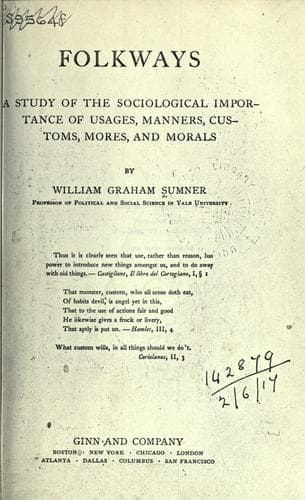
Folkways: A Study of the Sociological Importance of Usages, Manners, Customs, Mores, and MoralsSumner, William Graham
General
Folkways: A Study of the Sociological Importance of Usages, Manners, Customs, Mores, and Morals
Sumner, William Graham
Manners and customs
+193. Satires on fashion.+ Forty years ago a lady who swung her arms as
she walked was considered strong-minded. A lady who was young when the
present queen of England introduced the fashion of brushing up the hair
and uncovering the ears says that it seemed indecent. Fashion is
stronger than autocracy. Nicholas I of Russia disapproved of late hours
and ordered that court balls should be commenced early that they might
be finished early. He found himself almost alone until eleven o'clock,
and had to give up his reform.[408] In the height of the crinoline
fashion Leech published in _Punch_ a picture of two maiden ladies who
"think crinoline a preposterous and extravagant invention and appear at
a party in a simple and elegant attire." The shocked horror of the
bystanders is perfect, but the two ladies would to-day be quite in the
fashion. Du Maurier published in _Punch_ a skit in which a little girl
asked her mother how Eve knew, the first time that she saw Cain as a
baby, that he was not ugly. This is a very clever hit at the origin of
conventions. There was when Cain was born no established convention that
all babies are pretty.
+194. Fashion in faiths and ideals.+ There are also fashions in trading,
banking, political devices, traveling, inn keeping, book making, shows,
amusements, flowers, fancywork, carriages, gardens, and games. There
seem to be fashions in logic and reasoning. Arguments which are accepted
as convincing at one time have no effect at another (sec. 227, n. 4).
For centuries western Europe accepted the argument for the necessity of
torture in the administration of justice as convincing. At different
periods the satisfaction in allegory as a valid method of interpretation
has been manifested and the taste for allegory in the arts has appeared.
Philosophy goes through a cycle of forms by fashion. Even mathematics
and science do the same, both as to method and as to concepts. That is
why "methodology" is eternal. Mediaeval "realism" ruled all thought for
centuries, and its dominion is yet by no means broken. It prevails in
political philosophy now. Nominalism is the philosophy of modern
thought. Scholasticism held all the mental outfit of the learned. Thomas
Aquinas summed up all that man knows or needs to know. A modern man
finds it hard to hold his own attention throughout a page of it, even
for historical purposes. "Phlogiston" and "vortices" had their day and
are forgotten. Eighteenth-century deism and nineteenth-century
rationalism interest nobody any more. Eighteenth-century economists
argued in favor of stimulating population in order to make wages low,
and thereby win in international competition. They never had a
compunction or a doubt about this argument. No wonder it has been
asserted that all truth, except that which is mathematically
demonstrable, is only a function of the age. When the earth is
underpopulated and there is an economic demand for men, democracy is
inevitable.
Public-domain text, read in full here on John Shaqi.
Reviews
Reviews
No reviews yet
Be the first to share your thoughts on this work.
Elsewhere in the archive
Join the Discussion
Join the discussion
Sign in to leave a comment or review.
Sign InorCreate an account