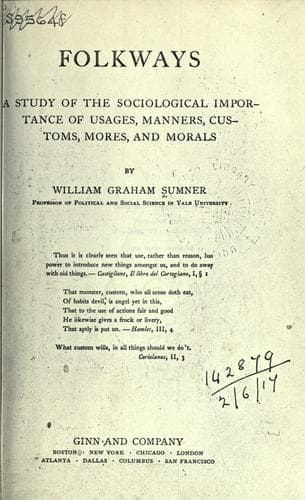
Folkways: A Study of the Sociological Importance of Usages, Manners, Customs, Mores, and MoralsSumner, William Graham
General
Folkways: A Study of the Sociological Importance of Usages, Manners, Customs, Mores, and Morals
Sumner, William Graham
Manners and customs
That state of things cannot be permanent. Therefore
democracy cannot last. It contains no absolute and "eternal" truth.
While it lasts a certain set of political notions and devices are in
fashion. Certain moral standards go with them. Evolution is now accepted
as a final fact in regard to organic phenomena. A philosophy of nature
is derived from it. Is it only a fashion,--a phase of thought? For to
all but a very few such a philosophy has no guarantee except that it is
current. All accept it because all accept it, and for no other reason.
Narrower philosophies become the fashion in classes, coteries, and
cliques. They are really affectations of something which wins prestige
and comes to be a badge of culture or other superiority. A few are
distinguished because they know Greek, or because they are
"freethinkers," or because they are ritualists, or because they profess
a certain cultus in art, or because they are disciples of Ruskin,
Eastlake, Carlyle, Emerson, Browning, Tolstoi, or Nietsche, and
cultivate the ideas and practices which these men have advocated as true
and wise. Often such fashions of thought or art pass from a narrow
coterie to a wider class, and sometimes they permeate the mores and
influence an age. When men believed in witches they did so because
everybody did. When the belief in witches was given up it was because a
few men set the fashion, and it was no longer "enlightened" to believe
in them.
+195. Fashion not trivial; not subject to argument.+ Fashion is by no
means trivial. It is a form of the dominance of the group over the
individual, and it is quite as often harmful as beneficial. There is no
arguing with the fashion. In the case of dress we can sometimes tell
what princess or actress started the fashion, and we sometimes know, in
the case of ideas, who set them afloat. Generally, however, it is not
known who started a fashion in dress. The authority of fashion is
imperative as to everything which it touches. The sanctions are ridicule
and powerlessness. The dissenter hurts himself; he never affects the
fashion. No woman, whatever her age or position or her opinion about the
crinoline fashion, could avoid wearing one. No effort to introduce a
fashion of "rational dress" for women has ever yet succeeded. An artist,
novelist, poet, or playwright of a school which is out of fashion fails
and is lost. An opponent of the notions which are current can get no
hearing. The fashion, therefore, operates a selection in which success
and merit are often divorced from each other, but the selection is
pitiless. The canons of criticism are set by fashion. It follows that
there is no rational effect of fashion. There was a rule in goblinism:
Say naught but good of the dead. The rule was dictated by fear that the
ghost would be angry and return to avenge the dead. The rule has come
down to us and is an imperative one. Eulogies on the dead are,
therefore, conventional falsehoods. It is quite impossible for any one
Public-domain text, read in full here on John Shaqi.
Reviews
Reviews
No reviews yet
Be the first to share your thoughts on this work.
Elsewhere in the archive
Join the Discussion
Join the discussion
Sign in to leave a comment or review.
Sign InorCreate an account