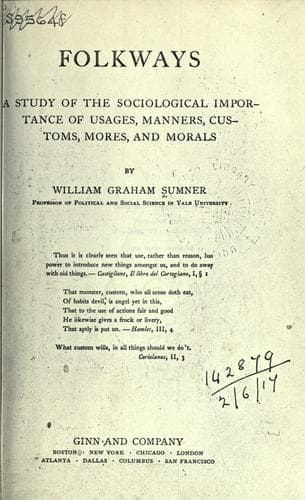
Folkways: A Study of the Sociological Importance of Usages, Manners, Customs, Mores, and MoralsSumner, William Graham
General
Folkways: A Study of the Sociological Importance of Usages, Manners, Customs, Mores, and Morals
Sumner, William Graham
Manners and customs
sports and games. The selective force of the social type of the
gentleman is obvious in our own society. The sentiment _noblesse oblige_
was once the name for the coercive force exerted on a noble by the code
of his class. Now that fixed classes are gone and the gentleman is only
defined by the usage and taste of an informal class, it is a term for
the duties which go with social superiority of any kind, so far as those
duties are prescribed and sanctioned by public opinion.
+210. Social standard set by taboos.+ It may be still more important to
notice that the standard social type is defined by taboos with only
social sanctions. The negative side of _noblesse oblige_ is more
important than the positive. A gentleman is under more restraints than a
non-gentleman. In the eighteenth century he patronized cockfights and
prize fights, and he could get drunk, gamble, tell falsehoods, and
deceive women without losing caste. He now finds that _noblesse oblige_
forbids all these things, and that it puts him under disabilities in
politics and business.
A society exerts a positive selection on individuals by its definition
of crimes and by its criminal jurisprudence. The taboos are turned into
laws and are enforced by positive penalties.
+211. Crimes.+ The number and variety of crimes depends on the positive
action of the state. What things are crimes in a state, therefore,
indicates what the ruling authority desires to prevent. The motives have
often been entirely selfish on the part of a king or a ruling caste, or
they were dictated by a desire to further the vanity of such persons. By
judicial precedent at Rome it was made a crime to beat a slave, or to
undress near a statue of the emperor, or to carry a coin bearing his
image into a latrine or a lupanar.[429] Xiphilin, in his epitome of the
history of Dio Cassius, inserts a story that, in the reign of Domitian,
a woman was executed for undressing near the statue of that
emperor.[430] The notions in the mores of what ought to be prevented
have been very variable and arbitrary. Juvenal denounces a consul who
while in office drove his own chariot, although by night.[431] Seneca
was shocked at the criminal luxury of putting snow in wine.[432] Pliny
is equally shocked at the fashion of wearing gold rings.[433] Lecky,
after citing these cases, refers to the denunciations uttered by the
church fathers against women who wore false hair. Painting the face is
an old fault of women, against which moral teachers of all ages have
thundered. Very recently, amongst us, clergymen have denounced women for
not wearing bonnets in church, because Paul said that she "dishonoreth
her head, for that is even all one as if she were shaven."[434] These
were not indeed cases of crimes, but of alleged vices or sins. In
sumptuary laws we have cases of legislation which made fashions crimes.
In the eighteenth century there was little legislation against brothels,
drinking places, or gambling houses.
Public-domain text, read in full here on John Shaqi.
Reviews
Reviews
No reviews yet
Be the first to share your thoughts on this work.
Elsewhere in the archive
Join the Discussion
Join the discussion
Sign in to leave a comment or review.
Sign InorCreate an account