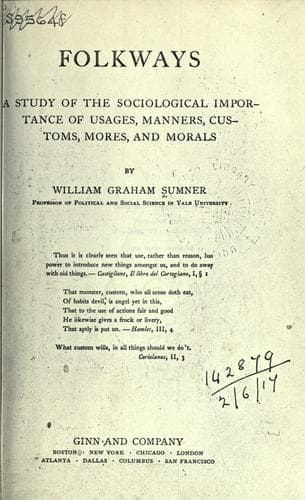
Folkways: A Study of the Sociological Importance of Usages, Manners, Customs, Mores, and MoralsSumner, William Graham
General
Folkways: A Study of the Sociological Importance of Usages, Manners, Customs, Mores, and Morals
Sumner, William Graham
Manners and customs
We make it a crime to sell rum, but
not to drink it. On the other hand, until recently commercial
transactions and the lending of money for interest were so restricted
in accordance with ethical and economic faiths that they were environed
by crimes which are now obsolete. Heresy and sorcery were once very
great crimes. Witchcraft and usury were abominable crimes.
+212. Criminal law.+ In the original administration of justice it
appears that there was only one punishment for the violation of taboo,
sin and crime being coincident: that was death. Then, in cases,
banishment was substituted for death, although this was only a change in
form, since a banished man could not exist alone. In either case the
selection was of the simplest kind. The society extruded from itself one
who violated its rules. This is the fundamental sense of all
punishments, like execution, transportation, or imprisonment, which
remove the culprit from the society, permanently or for a time. Other
punishments contained originally a large element of vengeance, vengeance
being a primary impulse of great force to satisfy those whom the crimes
injured and to deter others from the same crime. The administration of
justice, therefore, bore witness to the judgment of the society as to
what conduct and character should be selected for preservation or caused
to cease. In all modern states the power to make acts crimes has been
abused, and the motive of punishment has been so lost that we wrangle as
to what it is. The ruling coterie uses the power to make things crimes
to serve its own interests. Protectionists make it criminal to import
goods. Governments do the same to further their fiscal purposes. They
also make it criminal to immigrate or emigrate, or to coin money, even
of full weight and fineness, or to carry letters and parcels. In England
it is made a crime to violate railroad regulations. In some cases
regulations for barber shops are enforced by making violations crimes.
Generally, sanitary rules are so enforced. In the latest case it has
been made a crime to spit in public places. The criminal law expresses
the mores of the time when they have reached very concrete and definite
formulae of prohibition. Perhaps the administration of it expresses the
mores still more clearly. It is now recognized as true that frightful
penalties do not exert a proportionately deterrent effect. Our mores do
not permit us to inflict pain in order to compel men to confess, or to
put them in solitary confinement in dark and loathsome dungeons, or to
let our prisons become sinks of vice and misery or schools of crime. The
selective effect of punishment is the one which we seem to aim at,
although not very intelligently.
Public-domain text, read in full here on John Shaqi.
Reviews
Reviews
No reviews yet
Be the first to share your thoughts on this work.
Elsewhere in the archive
Join the Discussion
Join the discussion
Sign in to leave a comment or review.
Sign InorCreate an account