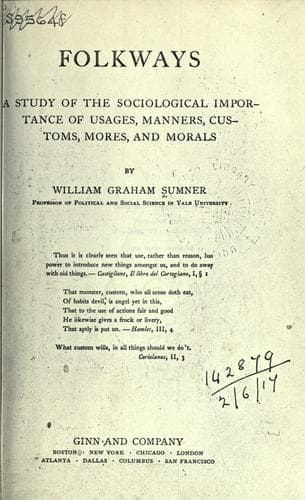
Folkways: A Study of the Sociological Importance of Usages, Manners, Customs, Mores, and MoralsSumner, William Graham
General
Folkways: A Study of the Sociological Importance of Usages, Manners, Customs, Mores, and Morals
Sumner, William Graham
Manners and customs
+214. Manias, delusions.+ The phenomena of manias, popular delusions,
group hallucinations, self-immolation, etc., show the possibilities of
mental contagion in a group. They are responses to hope or fear which
affect large numbers at the same time. They are often produced by
public calamities, or other ills of life. Those who suffer feel
themselves selected as victims, and they ask, Who has done this to us,
and why? Often people who are not victims interpret a natural incident
by egoistic reference. This is done not on account of the destruction
wrought by an earthquake or a tornado, but from pure terror at what is
not understood, e.g. an eclipse.[440] Pilgrimages and crusades were
cases of mania and delusion. The element of delusion was in the notion
of high merit which could be won in pursuing the crusades. Very often
manias and delusions are pure products of fashion, as in the case of the
children's crusades, when the children caught the infection of the
crusades, but did not know what they were doing, or why, and rushed on
their own destruction. Often manias are logical deductions from notions
(especially religious notions) which have been suggested, as in the case
of the flagellants. It is the ills of life which drive people to such
deductions, and they bear witness to excessive nervous excitement. The
mediaeval dancing mania was more purely nervous. The demonism and
demonology of the Middle Ages was a fertile source for such deductions,
which went far to produce the witchcraft mania. The demonistic notions
taught by the church furnished popular deductions, which the church took
up and reduced to dogmatic form, and returned as such to the masses.
Thus the notions of sorcery, heresy, and witchcraft were developed.
Public-domain text, read in full here on John Shaqi.
Reviews
Reviews
No reviews yet
Be the first to share your thoughts on this work.
Elsewhere in the archive
Join the Discussion
Join the discussion
Sign in to leave a comment or review.
Sign InorCreate an account