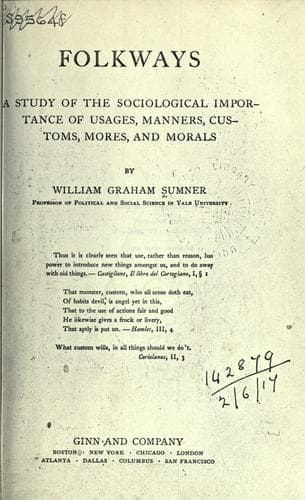
Folkways: A Study of the Sociological Importance of Usages, Manners, Customs, Mores, and MoralsSumner, William Graham
General
Folkways: A Study of the Sociological Importance of Usages, Manners, Customs, Mores, and Morals
Sumner, William Graham
Manners and customs
+215. Monstrous mass phenomena of mediaeval society.+ There must have
been a deep and strong anthropological reason for the development of
monstrous social phenomena in mediaeval society. The Latin world was
disintegrated to its first elements between the sixth century and the
tenth. Such a dissolution of society abolished the inherited mores with
all their restraints and inhibitions, and left society to the control of
fierce barbaric, that is physical, forces. At the same period the Latin
world absorbed hordes of barbarians who were still on a low nomadic
warrior stage of civilization, and who adopted the ruins of Roman
culture without assimilating them. The Christian church contributed
crass superstitions about the other world and the relations of this
world to it. The product was the Merovingian and Carlovingian history.
Passion, sensuality, ferocity, superstitious ignorance, and fear
characterized the age. It is supposed that western Europe was
overpopulated and that the crusades operated a beneficial reduction of
numbers.[441] These facts may account for the gigantic mass phenomena in
the early Middle Ages. Every sentiment was extravagant. Men were under
some mighty gregarious instinct which drove them to act in masses, and
they passed from one great passion or enthusiastic impulse to another at
very short intervals. The passions of hatred and revenge were
manifested, upon occasion, to the extremity of fiendishness. Nothing
which the mind could conceive of seemed to be renounced as excessive
(Clement V, John XXII). Gregory IX pursued the heretics and the emperor
with an absorption of his whole being and a rancor which we cannot
understand. Poverty was elevated into a noble virtue and a transcendent
merit.[442] This was the height of ascetic absurdity, since poverty is
only want, and the next step would be a cult of suicide. The mendicant
orders fought each other malignantly. Every difference of opinion made a
war of extermination. Civil contests were carried on with extravagant
ferocity as to the means used and as to the exultation of success or the
penalty of failure. What was lacking was discipline. There was no
authority or doctrine which could set limits to private passion. Life
was held cheap. The gallows and the pit were in use all the time. The
most marked product of invention was instruments of torture. Men and
women were burned to death for frivolous reasons. Punishments taught
people to gloat over suffering. Torture was inflicted as idly as we take
testimony. With all this went deep faith in the efficacy of ritual and
great other-worldliness, that is, immediate apprehension of the other
world in this one. All the mores were adjusted to these features of
faith and practice. It all proceeded out of the masses of the people.
The church was borne along like a chip on the tide. The church hung back
from the crusades until the depth of the popular interest had been
tested. Then the crusades were declared to be the "will of God." This
Public-domain text, read in full here on John Shaqi.
Reviews
Reviews
No reviews yet
Be the first to share your thoughts on this work.
Elsewhere in the archive
Join the Discussion
Join the discussion
Sign in to leave a comment or review.
Sign InorCreate an account