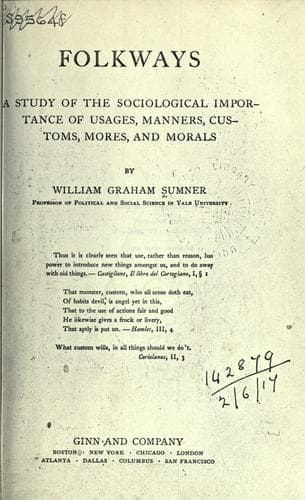
Folkways: A Study of the Sociological Importance of Usages, Manners, Customs, Mores, and MoralsSumner, William Graham
General
Folkways: A Study of the Sociological Importance of Usages, Manners, Customs, Mores, and Morals
Sumner, William Graham
Manners and customs
+216. Gregariousness of the Middle Ages.+ "To estimate fully the force
of these popular ebullitions in the Middle Ages, we must bear in mind
the susceptibility of the people to contagious emotions and enthusiasms
of which we know little in our colder day. A trifle might start a
movement which the wisest could not explain nor the most powerful
restrain. It was during the preaching of this crusade [of 1208, against
the Albigenses] that villages and towns in Germany were filled with
women who, unable to expend their religious ardor in taking the cross,
stripped themselves naked and ran silently through the roads and
streets. Still more symptomatic of the diseased spirituality of the time
was the crusade of the children, which desolated thousands of homes.
From vast districts of territory, incited apparently by a simultaneous
and spontaneous impulse, crowds of children set forth, without leaders
or guides, in search of the Holy Land; and their only answer, when
questioned as to their object, was that they were going to Jerusalem.
Vainly did parents lock their children up; they would break loose and
disappear; and the few who eventually found their way home again could
give no reason for the overmastering longing which had carried them
away. Nor must we lose sight of other and less creditable springs of
action which brought to all crusades the vile, who came for license and
spoil, and the base, who sought the immunity conferred by the quality of
crusader."[445] "To comprehend fully the magnitude and influence of
these movements we must bear in mind the impressionable character of the
populations and their readiness to yield to contagious emotion. When we
are told that the Franciscan Berthold of Ratisbon frequently preached to
crowds of sixty thousand souls, we realize what power was lodged in the
hands of those who could reach masses so easily swayed and so full of
blind yearnings to escape from the ignoble life to which they were
condemned. How the slumbering souls were awakened is shown by the
successive waves of excitement which swept over one portion of Europe
after another about the middle of the thirteenth century. The dumb,
untutored minds began to ask whether an existence of hopeless and brutal
misery was all that was to be realized from the promises of the gospel.
The church had made no real effort at internal reform; it was still
grasping, covetous, licentious, and a strange desire for something--they
knew not exactly what--began to take possession of men's hearts and
spread like an epidemic from village to village and from land to
land."[446]
Public-domain text, read in full here on John Shaqi.
Reviews
Reviews
No reviews yet
Be the first to share your thoughts on this work.
Elsewhere in the archive
Join the Discussion
Join the discussion
Sign in to leave a comment or review.
Sign InorCreate an account