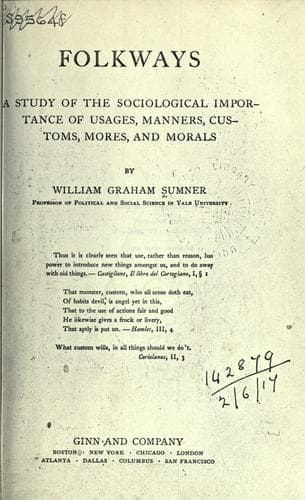
Folkways: A Study of the Sociological Importance of Usages, Manners, Customs, Mores, and MoralsSumner, William Graham
General
Folkways: A Study of the Sociological Importance of Usages, Manners, Customs, Mores, and Morals
Sumner, William Graham
Manners and customs
What we see here is the power of mere gregariousness, the impulse of
acting in a crowd, without knowledge or purpose. The mere sense of being
in the current movement, or "in the fashion," is a pleasure. When the
movement is great in its compass and the numbers involved there is an
exhilaration about being in it. If the notions by which it is enthused
are great, or holy and noble, in form and pretense, even if not really
so, it may become demonic, and it may accomplish incredible things. We
had a grand illustration of this at the outbreak of the Civil War, in
1861, both in the North and South. Dissent on both sides was overwhelmed
and all were swept away into the prevailing current.
+217. The mendicant orders.+ The mendicant orders responded to the
deepest popular faiths and highest standards of the thirteenth century.
Francis of Assisi ([Symbol: cross] 1226) took up the notion that it was
wrong to own property, or at least meritorious to renounce it, and
affirmed that Christ and his apostles repudiated all property and lived
on alms. The Timotheists of the fifth century had held this notion, but
were rated as heretics.[447] Poverty, for Francis, did not mean a little
property, but absolute rejection of all property. This was necessarily
only a pose. He had to use other men's property, the use being right.
Therefore he could only renounce productive labor. The popular religious
temper of the time revered simplicity, humility, self-denial, and
renunciation of "the world" as especially evangelical virtues. They were
thought to be summed up in poverty. That Francis was a hero of this type
of religion has been universally admitted. The virtues were just the
ones which the Roman court did not show. Jacques de Vitry, an
enthusiastic preacher against the Albigenses, went through Italy to
Palestine in 1216. He left a journal[448] in which he recorded his
sadness at observing that, at the papal court, all were busy with
secular affairs, kings and kingdoms, quarrels and lawsuits, so that it
was almost impossible to speak about spiritual matters. He greatly
admired the Franciscans, who were trying to renew primitive Christianity
and save souls, thus shaming the prelates, who were "dogs who do not
bark." The Count of Chiusi gave to Francis the mountain La Verna for
retirement and meditation. Armed men were necessary to take possession
of it against the beasts and robbers who had possession of it.[449]
Carmichael believes that Francis received the stigmata, which he
describes in detail. The Francis of tradition is a fabulous person,
created out of the pet ideas of his time.[450] The historical person was
a visionary. Dominic was a zealot. He wanted to convert all heretics by
preaching or other means.
Public-domain text, read in full here on John Shaqi.
Reviews
Reviews
No reviews yet
Be the first to share your thoughts on this work.
Elsewhere in the archive
Join the Discussion
Join the discussion
Sign in to leave a comment or review.
Sign InorCreate an account