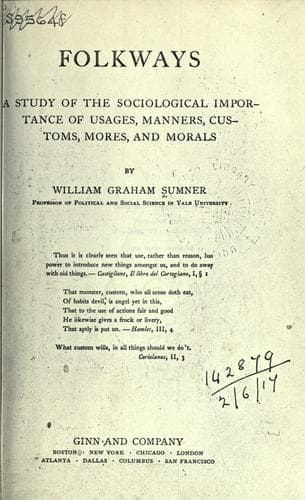
Folkways: A Study of the Sociological Importance of Usages, Manners, Customs, Mores, and MoralsSumner, William Graham
General
Folkways: A Study of the Sociological Importance of Usages, Manners, Customs, Mores, and Morals
Sumner, William Graham
Manners and customs
+218. Other mendicant orders.+ De Vitry found Humiliati in
Lombardy, who were living by ideas like those of Francis. The
Augustinian hermits were founded in 1256, the Carmelites in 1245,
and the Servites, or Servants of Mary, about 1275.[451] These
were all mendicants, and they bear witness to the character of
the notions of the time about poverty. It was a mania, and is
fully expressed in the _Romaunt de la Rose_. Perhaps Francis did
not mean to "found an order." He wanted to live in a certain way
with a few friends. The spontaneous and very rapid spread of his
order proves that it was concordant with a great popular taste.
Francis was a dreamer and enthusiast, not a politician or
organizer at all. In his testament he says: "After the Lord had
given me care of the brethren, no one showed me what I ought to
do, but the Highest Himself revealed to me that I ought to live
according to the mode of the Holy Gospel." He was not thwarted
and subjugated by the curia during his life, but his ideals were
not maintained by the men in the order. The man who was later
pope Gregory IX aided him to organize the order and to make it
practically efficient, that is, to take the enthusiasm out of it
and make it practical.[452] The popes of the thirteenth century
approved. There was in the principles of the order an antagonism
to the church as it was, and also an antagonism to common sense.
The church authorities wanted to bring the order into practical
use, and suspected it of the heresies of Florus. It therefore
split into "conventuals," who conformed to the methods of
conventual life, and the "spirituals," who clung to the doctrines
and rules of the founder. The latter became "observantines"
(1368) and "recollects" (1487).[453] The two branches hated each
other and fought on all occasions. In 1275 the spirituals were
treated as heretics, imprisoned in chains, and forbidden the
sacrament.[454] John XXII condemned their doctrine as heretical.
This put the observantines in the same position as other
heretical sects. They must be rebels and heretics or give up
ideas which seemed to them the sum of all truth and wisdom.
Generally they clung to their ideas like the heretics.[455] One
of their heroes was Bernard Delicieux ([Symbol: cross] 1320), who
is celebrated as the only man who ever dared to resist the
Inquisition. He was tortured twice, and condemned to imprisonment
in chains on bread and water. He lived only a few months under
this punishment.[456] Out of admiration immense sums were given
to the mendicants, and they became notorious for avarice and
worldly self-seeking.[457] As early as 1257 Bonaventura, the head
of the order, reproached them with these faults.[458] "Some of
the venomous hatred expressed by the Italian satirists for the
two great orders of St. Francis and St. Dominic may perhaps be
Public-domain text, read in full here on John Shaqi.
Reviews
Reviews
No reviews yet
Be the first to share your thoughts on this work.
Elsewhere in the archive
Join the Discussion
Join the discussion
Sign in to leave a comment or review.
Sign InorCreate an account