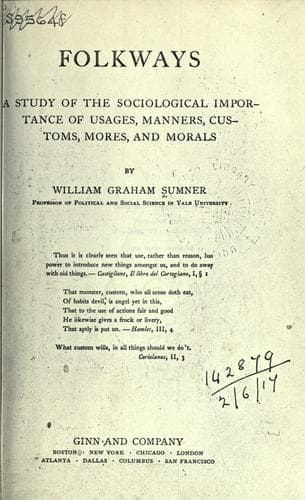
Folkways: A Study of the Sociological Importance of Usages, Manners, Customs, Mores, and MoralsSumner, William Graham
General
Folkways: A Study of the Sociological Importance of Usages, Manners, Customs, Mores, and Morals
Sumner, William Graham
Manners and customs
+236. Solidarity of group in penalty incurred by one.+ In primitive
society any one who departed from the ways of ancestors was supposed to
offend their ghosts; furthermore, he was supposed to bring down their
avenging wrath on the whole group of which he was a member. This idea
has prevailed until modern times. It aroused the sentiment of vengeance
against the dissenter, and united all the rest in a common interest
against him. Especially, if any misfortune befell the group, they turned
against any one who had broken the taboos. Thus goblinism was united to
the other reasons for disliking dissenters and gave it definite
direction and motive. At Rome, "in the days of the republic, every
famine, pestilence, or drought was followed by a searching investigation
of the sacred rites, to ascertain what irregularity or neglect had
caused the divine anger, and two instances are recorded in which vestal
virgins were put to death because their unchastity was believed to have
provoked a national calamity."[517] In the Roman law is found a
proposition which was often quoted in the Middle Ages: "That which is
done against divine religion is done to the harm of all."[518] Hale[519]
explains the tortures inflicted by the Iroquois, by their desire to mark
some kinds of Indian warfare as very abominable, and so to drive them
out of use. Torture always flatters vanity. He who inflicts it has
power. To reduce, plunder, and torment an enemy is a great luxury. The
lust of blood is a frightful demon when once it is aroused. A Hungarian
woman of noble birth, at the beginning of the seventeenth century,
tortured to death thirty or forty of her maidservants. She began by
inflicting severe punishments and developed a fiendish passion for the
sight of suffering and blood.[520] It is the combinations of the other
elements, religion, ambition, sex, vanity, and the lust of blood, with
the dislike of dissenters, which has caused the most frightful
developments of torture and persecution. This brings us to the case of
the mediaeval inquisition. It is not to be expected that a phenomenon of
high civilization will be simple and uniform. So the motives of
Christian persecution to enforce conformity are numerous and mixed. It
was directly against some of the leading principles of Christianity, but
there are texts in the New Testament which were used to justify it.[521]
Public-domain text, read in full here on John Shaqi.
Reviews
Reviews
No reviews yet
Be the first to share your thoughts on this work.
Elsewhere in the archive
Join the Discussion
Join the discussion
Sign in to leave a comment or review.
Sign InorCreate an account