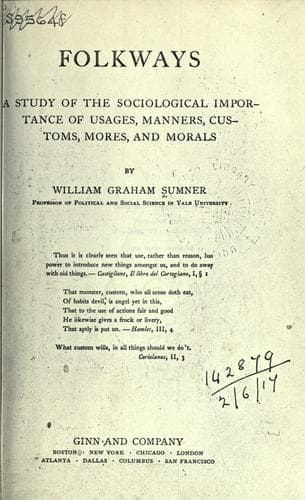
Folkways: A Study of the Sociological Importance of Usages, Manners, Customs, Mores, and MoralsSumner, William Graham
General
Folkways: A Study of the Sociological Importance of Usages, Manners, Customs, Mores, and Morals
Sumner, William Graham
Manners and customs
+237. Torture in ancient states.+ The Egyptians used torture in all
ordinary investigations to find out the facts.[522] The Greeks had used
torture. It was common in the Periclean age in the courts of Athens. The
accused gave his slaves to be tortured "to challenge evidence against
himself."[523] Plutarch[524] tells of a barber who heard of the defeat
of Nicias in Sicily and ran to tell the magistrates. They tortured him
as a maker of trouble by disseminating false news, until the story was
confirmed. Philotas was charged with planning to kill Alexander. He was
tortured and the desired proof was obtained.[525] Eusebius,[526]
describing the persecution under Nerva, says that Simeon, Bishop of
Jerusalem, being one hundred and twenty years old, was tortured for
several days and then crucified. Torture underwent a special development
in the Euphrates valley. The Assyrian stones show frightful tortures
which kings sometimes inflicted with their own hands. Maiming, flaying,
impaling, blinding, and smothering in hot ashes became usual forms in
Persia. They passed to the Turks, and the stories of torture and death
inflicted in southeastern Europe, or in modern Persia, show knowledge
and inventive skill far beyond what the same peoples have otherwise
shown. The motives have been religious contempt, hereditary animosity,
and vengeance, as well as political and warlike antagonism.
+238. Torture in the Roman empire.+ The Roman emperors lived in a great
fear of supernatural attack. There was a very great interest for many
people in the question: When will the emperor die? Many, no doubt, made
use of any apparatus of astrology or sorcery to find out. To the emperor
and his adherents this seemed to prove a desire that he should die, and
was interpreted as treasonable. The Christians helped to develop
demonism. They regarded all the heathen gods as demons. As they gained
power in society this notion spread, and there was a great revival of
popular demonism. By the _lex Julia de Majestate_ torture might be
applied to persons charged with treason, and the definition of treason
was greatly enlarged. Torture was used to great excess under Tiberius
and Nero. In the fourth century, after the emperors became Christians,
it was feared that persons who hated them would work them ill by sorcery
with the aid of the demons, formerly heathen gods. Sorcery and treason
were combined and strengthened by a great tide of superstition which
overspread the Roman world.[527] The first capital punishment for heresy
in the Christian church seems to have been the torture and burning of
Priscillian, a Manichaean, at Treves, in 385, with six of his adherents,
by the Emperor Maximus. This act caused a sensation of truly Christian
horror. Of the two bishops who were responsible, one was expelled from
his see; the other resigned.[528] In 579 King Chilperic caused
ecclesiastics to be tortured for disloyal behavior. About 580 the same
Public-domain text, read in full here on John Shaqi.
Reviews
Reviews
No reviews yet
Be the first to share your thoughts on this work.
Elsewhere in the archive
Join the Discussion
Join the discussion
Sign in to leave a comment or review.
Sign InorCreate an account