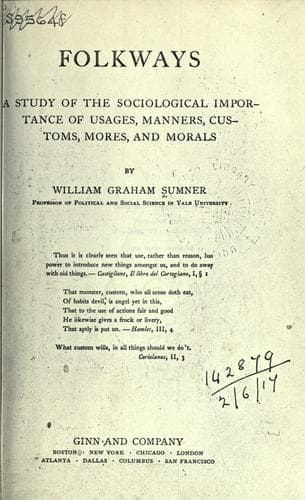
Folkways: A Study of the Sociological Importance of Usages, Manners, Customs, Mores, and MoralsSumner, William Graham
General
Folkways: A Study of the Sociological Importance of Usages, Manners, Customs, Mores, and Morals
Sumner, William Graham
Manners and customs
king, having married a servant maid, an act which caused family and
political trouble, upon the death of two of her children, caused a woman
to be tortured who was charged with murdering the children in the
interest of their stepbrother. She confessed, revoked her confession,
and was burned. Three years later another child of the queen died, and
several women were tortured and burned or broken on the wheel for
causing the death by sorcery.[529] Pope Nicholas I, in 866, opposed the
use of torture as barbaric, and the pseudo-Isidorian Decretals take the
same position in regard to it. Indeed, that was the orthodox Christian
view in the dark ages.
+239.+ Such was the course of descent by which torture came to the
Middle Ages. It was in connection with the revival of the eleventh
century that the Roman law of treason was made to apply to heresy by
construing it as treason to God.[530] It is, however, of the first
importance to notice that it was the masses which first applied death by
burning to heretics. The mob lynched heretics long before the church
began to persecute.[531] (See, further, sec. 253.)
+240. Jewish and Christian universality. Who persecutes whom?+ The Jews
held that their God was the only real God. The gods of other nations
were "vanity," that is, nullity. They held that their religion was the
only true one. When about the time of the birth of Christ they stepped
before the Greco-Roman world with this claim, it cost them great hatred
and abuse. In the history of religion it counts as a great fact of
advance in religious conceptions. Christianity inherited the idea and
applied it to itself. It has always claimed to be absolutely and alone
true as a religious system. Every other religion is an invader of its
domain. It was this attitude which gave a definition to heresy. Under
paganism "speculation was untrammeled. The notion of there being any
necessary guilt in erroneous opinion was unknown."[532] When once this
notion found acceptance it produced a great number of deductions and
corollaries and gave form to a great number of customs, such as they had
never had before. The effect on the selection of articles of faith out
of the doctrines of warring sects and philosophies is obvious, also the
effect on methods of controversy. The effects are important in the
fourth and fifth centuries, and the notion became one of the postulates
of all thinking. This is the ultimate reason for the wickedness of
heresy and for the abomination of all heretics. Certainly Christianity
did not, in this matter, improve on the philosophy of paganism. It was
this attitude of Christianity and its neglect of the existing political
authority which drew upon it the contempt, derision, and hatred of the
heathen. The persecution of Christians was popular. It expressed the
popular feeling, which was more constantly expressed in the popular
comedy and the improvised popular play.[533] The persecution in Nerva's
Public-domain text, read in full here on John Shaqi.
Reviews
Reviews
No reviews yet
Be the first to share your thoughts on this work.
Elsewhere in the archive
Join the Discussion
Join the discussion
Sign in to leave a comment or review.
Sign InorCreate an account