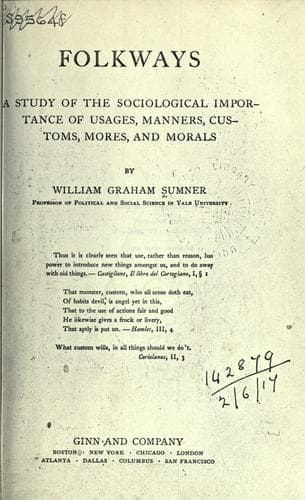
Folkways: A Study of the Sociological Importance of Usages, Manners, Customs, Mores, and MoralsSumner, William Graham
General
Folkways: A Study of the Sociological Importance of Usages, Manners, Customs, Mores, and Morals
Sumner, William Graham
Manners and customs
time was more popular than political.[534] In the following century the
Christians denounced heathenism as a worship of demons. "It is not
surprising that the populace should have been firmly convinced that
every great catastrophe that occurred was due to the presence of the
enemies of the gods."[535] "The history of the period of the Antonines
continually manifests the desire of the populace to persecute,
restrained by the humanity of the rulers."[536] In the third century the
Decian persecution was largely due to the "popular fanaticism caused by
great calamities, which were ascribed to the anger of the gods at the
neglect of their worship."[537] "The most horrible recorded instances of
torture were usually inflicted, either by the populace, or in their
presence, in the arena."[538] Frightful tortures were inflicted in the
attempt to make Christians sacrifice to the heathen gods. This effort
was due to the popular apprehension of solidarity in responsibility for
the neglect by the Christians of the state gods, to the decline of all
social welfare and the implied insult to the state. In the fourth
century Christianity became the religion of the state and took up the
task of persecuting the heathen. "The only question is: In whose hands
is the power to persecute?" That question alone determines who shall
persecute whom. Literature was produced which uttered savage hatred
against all who were not fully orthodox, and the sects practiced
violence and cruelty against each other to the full extent for which
they found opportunity. "Never, perhaps, was the infliction of
mutilation, and prolonged and agonizing forms of death, more common"
than in the seventh and eighth centuries.[539] "Great numbers were
deprived of their ears and noses, tortured through several days, and at
last burned alive or broken slowly on the wheel."[540] At Byzantium, in
the ninth century, a prefect of the palace was burned in the circus for
appropriating the property of a widow. It became the custom that capital
punishments were executed in the circus.[541] All this course of things
was due to popular tastes and desires, and it was a course of popular
education of the masses in cruelty, love of bloodshed, and gratification
of low hatred and other base passions. All the laws, the exhortations of
the clergy, and the public acts of torture and execution held out the
suggestion that heresy was a thing deserving the extremest horror and
abomination. What was heresy? No one knew unless he was an educated
theologian, and such were rare. The vagueness of heresy made it more
terrible. "The long-continued teaching of the church, that persistent
heresy was the one crime for which there could be no pardon or excuse,
seemed to deprive even the wisest and purest of all power of reasoning
where it was concerned."[542]
Public-domain text, read in full here on John Shaqi.
Reviews
Reviews
No reviews yet
Be the first to share your thoughts on this work.
Elsewhere in the archive
Join the Discussion
Join the discussion
Sign in to leave a comment or review.
Sign InorCreate an account