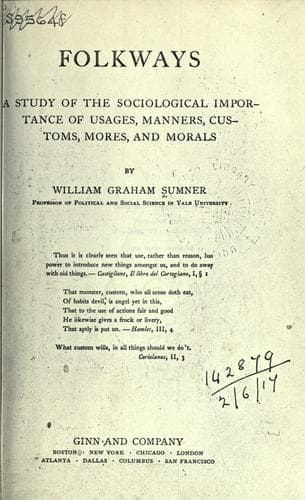
Folkways: A Study of the Sociological Importance of Usages, Manners, Customs, Mores, and MoralsSumner, William Graham
General
Folkways: A Study of the Sociological Importance of Usages, Manners, Customs, Mores, and Morals
Sumner, William Graham
Manners and customs
+251. Duties laid on the civil authority.+ The secular authority
accepted the functions allotted to it out of the spirit of the age. To
fall into disfavor at Rome was, for a prince, to risk the loyalty of his
subjects, with whom it was a point of high importance to belong to a
"Christian" state, that is, one on good terms with the church. "We are
not to imagine, however, from these reduplicated commands that the
secular power, as a rule, showed itself in the slightest degree
disinclined to perform the duty. The teachings of the church had made
too profound an impression for any doubt in the premises to exist. As
has been seen above, the laws of all the states of Europe prescribed
concremation as the appropriate penalty for heresy, and even the free
commonwealths of Italy recognized the Inquisition as the judge whose
sentences were to be blindly executed."[569]
+252.+ "The practice of burning the heretic alive was thus not the
creature of positive law, but arose generally and spontaneously, and its
adoption by the legislator was only the recognition of a popular
custom."[570] "Confession of heresy became a matter of vital importance,
and no effort was deemed too great, no means too repulsive, to secure
it. This became the center of the inquisitorial process, and it is
deserving of detailed consideration, not only because it formed the
basis of procedure in the Holy Office, but also because of the vast and
deplorable influence which it exercised for five centuries on the whole
judicial system of continental Europe."[571] In the second half of the
twelfth century burning had become, by custom, the usual punishment for
heretics. The purpose was universally regarded as right and pious, and
the means was thought wise and correct. Therefore the whole procedure
went forward on a course of direct and consistent development.[572] It
was first decreed in positive law in the code of Pedro II, of Aragon, in
1197. In the laws of Frederick II, in 1224, the punishment was death by
burning or loss of the tongue. In 1231, in Sicily, burning was made
absolute. In 1238 the stake was made the law of the empire against
heresy. In 1270 Louis IX made it the law of France.[573] "Dominic and
Francis, Bonaventura and Thomas Aquinas, Innocent III and St. Louis,
were types, in their several ways, of which humanity, in any age, might
well feel proud, and yet they were as unsparing of the heretic as
Ezzelino da Romano was of his enemies. With such men it was not hope of
gain or lust of blood or pride of opinion or wanton exercise of power,
but sense of duty, and they but represented public opinion from the
thirteenth to the seventeenth century."[574] That is to say, that the
virtues of the individuals were overruled by the vices of the mores of
the age.
Public-domain text, read in full here on John Shaqi.
Reviews
Reviews
No reviews yet
Be the first to share your thoughts on this work.
Elsewhere in the archive
Join the Discussion
Join the discussion
Sign in to leave a comment or review.
Sign InorCreate an account