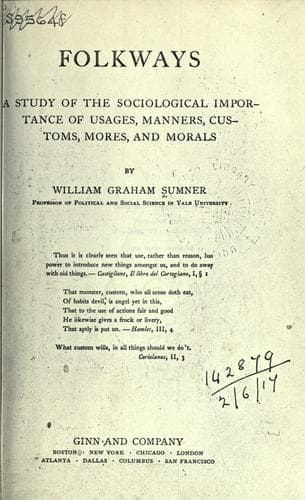
Folkways: A Study of the Sociological Importance of Usages, Manners, Customs, Mores, and MoralsSumner, William Graham
General
Folkways: A Study of the Sociological Importance of Usages, Manners, Customs, Mores, and Morals
Sumner, William Graham
Manners and customs
+253. The shares of the church and the masses.+ The steps of the process
by which the Christian church was made an organization to enforce
uniformity of confession by bodily pain, that is, in fact, by murder,
demand careful attention. Back of all the popular demands for
persecution there was the teaching of the church in antecedent periods
and a crude popular logic of detestation and destruction. Then the
outbreak of persecution appears as a popular act with lynching
executions. At this point the church, by virtue of its teaching and
leading functions, ought to have repressed excessive zeal and guided the
popular frenzy. It did not do so. It took the lead of the popular
movement and encouraged it. This was its greatest crime, but it must be
fairly understood that it acted with public opinion and was fully
supported by the masses and by the culture classes. The Inquisition was
not unpopular and was not disapproved. It was thought to be the proper
and necessary means to deal with heresy, just as we now think police
courts necessary to deal with petty crimes (see sec. 247). The system of
persecution went on to extravagances. The masses disapproved. They could
not be held to any responsibility. They turned against the
ecclesiastical authorities and threw all the blame on them.
+254. The church uses the power for selfish aggrandizement.+ Things now
advanced, therefore, to the second stage. The church authorities
accepted the executive duty in respect to the defense of the church and
society against heresy. The popular idea was that heresy would bring
down the wrath of God on all Christendom, or on the whole of the small
group in which it occurred.[575] The church authorities formulated
doctrines, planned programmes, and appointed administrative officers. To
them the commission laid upon them meant more social power, and they
turned it into a measure of selfish aggrandizement. This alienated first
all competent judges, and at last the masses.
Public-domain text, read in full here on John Shaqi.
Reviews
Reviews
No reviews yet
Be the first to share your thoughts on this work.
Elsewhere in the archive
Join the Discussion
Join the discussion
Sign in to leave a comment or review.
Sign InorCreate an account