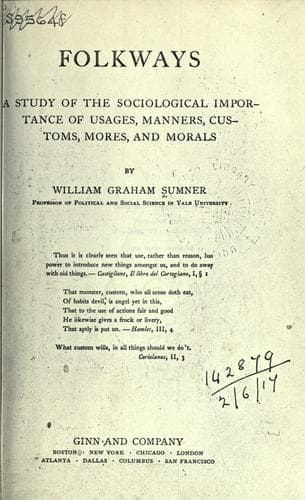
Folkways: A Study of the Sociological Importance of Usages, Manners, Customs, Mores, and MoralsSumner, William Graham
General
Folkways: A Study of the Sociological Importance of Usages, Manners, Customs, Mores, and Morals
Sumner, William Graham
Manners and customs
+262. Torture in civil and ecclesiastical trials.+ (See sec. 237
ff.) In the course of its work the Inquisition had introduced
torture into the administration of Christian justice and into the
mores. The jurists were all corrupted by it. They supposed that,
without torture, no crimes could be detected or punished, and
this opinion ruled the administration of justice on the continent
until the eighteenth century.[593] Lea finds the earliest
instances of legal torture in the Veronese Code of 1228, and in
the Sicilian Constitutions of 1231;--work of the rationalist
emperor, Frederick II, but it was "sparingly and hesitatingly
employed." Innocent IV adopted it in 1252, but only secular
authorities were to use it. This was to save the sanctity of
ecclesiastics. In 1256 Alexander IV, "with characteristic
indirection," authorized inquisitors and their associates to
absolve each other, and grant dispensations for irregularities.
This gave them absolute liberty, and they could inflict or
supervise torture.[594] There were other "poses," such as the
prohibition to shed blood, i.e. to break the skin, and the rule
to ask the civil power, when surrendering the victim to it, not
to proceed to extremes, although it was bound to burn the victim.
As the system continued in practice its methods were refined and
its experts were trained. Any one who was charged must be
convicted if possible. The torture produced permanent crippling
or maiming. It would not do to release any one so marked with the
investigation and then acquitted. Hence more and more frightful
measures became necessary. Nevertheless cases occurred in which
the accused held out beyond the power of the persecutors.[595] At
Bamberg, in 1614, a woman seventy-four years old endured torture
up to the third grade. After three quarters of an hour on the
"Bock" she fell dead. The verdict was that she had cleared
herself, by enduring the torture, of the "evidence" against her,
and would have been freed if she had lived. She was to have
Christian burial, and a document attesting this finding was to be
given to her husband and children. Some jurists of the sixteenth
and seventeenth centuries were led to doubt about torture, but
they almost all agreed that it was necessary "in some cases."
These were the reformers who were careful not to be extremists.
We are told that Peter of Ravenna, in 1511, urged the abolition
of torture, and that Louis Vivez, a Spaniard, took the same
position a little later. Neither won any attention.[596] In the
Carolina, Charles V's law book of 1532, which was in general
savage in its penalties, torture was to be applied only in cases
punishable by death or life imprisonment, and only on strong
prima facie evidence of guilt. Confession under torture was to
have no weight unless confirmed after an interval. These
Public-domain text, read in full here on John Shaqi.
Reviews
Reviews
No reviews yet
Be the first to share your thoughts on this work.
Elsewhere in the archive
Join the Discussion
Join the discussion
Sign in to leave a comment or review.
Sign InorCreate an account