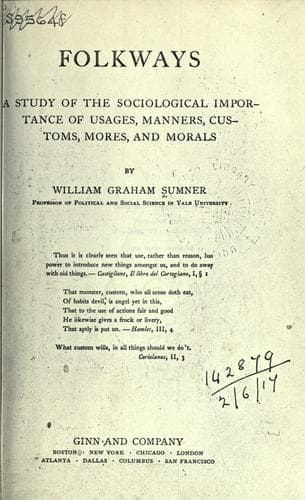
Folkways: A Study of the Sociological Importance of Usages, Manners, Customs, Mores, and MoralsSumner, William Graham
General
Folkways: A Study of the Sociological Importance of Usages, Manners, Customs, Mores, and Morals
Sumner, William Graham
Manners and customs
restrictions were not observed in practice.[597] There are very
many cases on record in which it was afterwards proved that many
persons had suffered torture and cruel execution, upon
confession, who were innocent of all crime.[598]
+263. The selection accomplished.+ Thus the apparatus and devices for
putting down dissent and enforcing submission to such authority as the
great number were willing to recognize had attained a superficial
success. Opposition was silenced. Dissent was made so dangerous that no
one dared express it, except here and there a hero, and outward
conformity to church discipline was almost universal. The mores also
underwent influence from a societal power which was great and pervading.
The external and artificial character of the conformity was so well
known that a name was given to it,--_implicita fides_,--and this was
discussed as to its nature and value. The mores are gravely affected by
_implicita fides_ when it is held by a great number of persons.[599] The
selection which had destroyed honest thinkers and sincere churchmen had
cultivated a class of smooth hypocrites and submissive cowards. In the
fifteenth century the whole of Christendom had accepted the church
system with its concepts of welfare and its dictates of duty, and had
adopted the ritual means of holiness and salvation which it prescribed.
In fact, at no other time were men ever so busy as then with "good
works," or so fussy about church ritual. Everybody was anxious not to be
a heretic. At the same time the whole mediaeeval system was falling to
pieces, and the inventions and discoveries were disproving all received
and approved ideas about the world and welfare in it. Gross sensuality
and carnal lust got possession of society, and the church system was an
independent system of balancing accounts with the other world. The
theater declined into obscenity and coarseness, and the popular pulpit
was hardly better.[600] The learned world was returning to classical
paganism. The popes had their children in the Vatican and publicly
married them there. Under Sextus IV the courtesans at Rome paid a tax
which produced 20,000 ducats per annum. Prelates owned brothels.
Innocent VIII tried to stop the scandal. In 1490 his vicar published an
edict against all concubinage, but the pope forced him to recall it
because all ecclesiastics had concubines. There were 6800 public
meretrices at Rome besides private ones and concubines. Concubinage was
really tolerated, subject to the payment of an amercement.[601] The
proceedings under Alexander VI were only the culmination of the license
taken by men who were irresponsible masters of the world, and who showed
the insanity of despotism just as the Roman emperors did.[602] The
church had broken down under the reaction of its own efforts to rule the
world. It had made moral hypocrisy and religious humbug characteristic
of Christians, for he who indulges in sensual vice and balances it off
Public-domain text, read in full here on John Shaqi.
Reviews
Reviews
No reviews yet
Be the first to share your thoughts on this work.
Elsewhere in the archive
Join the Discussion
Join the discussion
Sign in to leave a comment or review.
Sign InorCreate an account