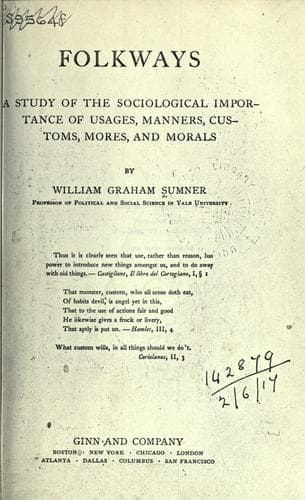
Folkways: A Study of the Sociological Importance of Usages, Manners, Customs, Mores, and MoralsSumner, William Graham
General
Folkways: A Study of the Sociological Importance of Usages, Manners, Customs, Mores, and Morals
Sumner, William Graham
Manners and customs
+279. Slavery in Polynesia and Melanesia.+ Polynesia, Melanesia,
and the East Indies, especially the last, present us pictures of
a society which is old and whose mores have been worn threadbare,
while their stage of civilization is still very low.
Codrington[696] says: "There is no such thing as slavery,
properly so called. In head-hunting expeditions prisoners are
made for the sake of their heads, to be used when occasion
requires, and such persons live with their captors in a condition
very different from that of freedom, but they are not taken or
maintained for the purposes of slaves." Ratzel[697] says:
"Slavery prevailed everywhere in Melanesia, originating either in
war or debt. Sometimes it was hard; sometimes not." Somerville
says that "slaves are kept chiefly for their heads, which are
demanded whenever any occasion necessitates them, such as the
death of the owner." He is speaking of the Solomon Islands.[698]
What Finsch says of the Melanesians may be extended to all the
inhabitants of the South Sea islands.[699] They will not work
because they do not need to. They have few wants. Pfeil wants to
make the people of German Melanesia work, in order that they may
contribute to the tasks of the human race. The problem presents
one of the great reasons for slavery in history.
+280. Slavery in the East Indies.+ The chief of Chittagong[700]
wrote to the English governor, in 1774, that slavery in his
district was due to the sale of himself by any person who was
destitute, and had no friends or position. He and his wife must
serve the master and his wife in any desired way, including
services which a free servant would not perform, "through fear of
demeaning himself and disgracing his family." Abolition of this
slavery would produce complaints by the masters, and would not
please the servants who are used to it. "Until lately the
universal custom prevailed in the hills of having debtor slaves."
The debtor gave one of his children or a female relative to serve
as a menial until the debt should be paid. The pawned persons
"were treated as members of the creditor's family and never
exposed to harsh usage." The effect of interference by the
English was that the wives and daughters of the great men
suddenly had to do all the housework. "Debtor and creditor lost
confidence in each other."[701] "There is a detestable and actual
slavery in these hills, which is now only carried on by
independent tribes, beyond English jurisdiction. This is the
captivity to the bow and spear,--men and women taken prisoners by
force in war, and sold from master to master. The origin of this
custom was the want of women."[702] In the Chin hills there are
slaves who are war captives, or criminals, or debtors, and others
who are voluntary slaves, or slaves by birth. The master had full
Public-domain text, read in full here on John Shaqi.
Reviews
Reviews
No reviews yet
Be the first to share your thoughts on this work.
Elsewhere in the archive
Join the Discussion
Join the discussion
Sign in to leave a comment or review.
Sign InorCreate an account