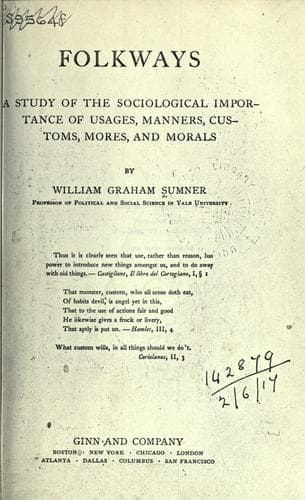
Folkways: A Study of the Sociological Importance of Usages, Manners, Customs, Mores, and MoralsSumner, William Graham
General
Folkways: A Study of the Sociological Importance of Usages, Manners, Customs, Mores, and Morals
Sumner, William Graham
Manners and customs
power of life and death, but, in fact, slaves were well treated.
The people made raids on the Burmese lowlands and seized captives
who were held for ransom. A slave man cohabits with a slave woman
and brings up his children with affection "in the same humble,
but not necessarily unhappy, position as his own."[703] In Ceylon
there were slave persons of all ranks. Those of royal rank were
princes who were prisoners or criminals. Any one might obtain
slaves by purchase, or accept voluntary slaves who looked to him
for good support.[704] A Malay will buy of a chief a number of
war captives whom he takes to an island. Then he goes to a
Chinaman and tells him that the slaves want to work on that
island, but still owe the speaker the cost of transportation. The
Chinaman pays this and gives to the slaves, on credit, clothes,
etc., including money with which to gamble. Wages are low and
interest high. They never can pay their debts and get their
freedom again. This kind of slave trade has depopulated northern
Nias.[705] On Sumatra, when a debtor is called upon to pay and
cannot, or when he dies and does not leave enough property to pay
his debts, his children fall into semi-slavery. They can perhaps
persuade some one to pay their debts and accept their services.
If their master formally three times demands payment of them
which they cannot give, they fall into full slavery. Slavery
exists in the Malay seaport towns, but not in the rural
districts, where life is too simple.[706] In times of famine and
want parents sell their children into slavery for a little rice.
Children, especially daughters, constitute a large part of the
fortune of a house father.[707]
Public-domain text, read in full here on John Shaqi.
Reviews
Reviews
No reviews yet
Be the first to share your thoughts on this work.
Elsewhere in the archive
Join the Discussion
Join the discussion
Sign in to leave a comment or review.
Sign InorCreate an account