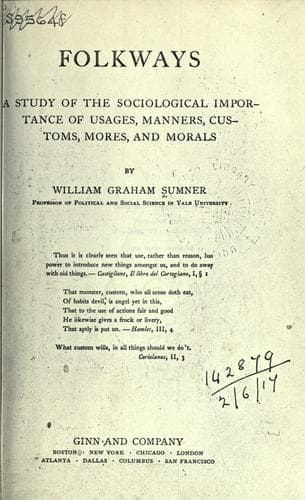
Folkways: A Study of the Sociological Importance of Usages, Manners, Customs, Mores, and Morals — John Shaqi
Folkways: A Study of the Sociological Importance of Usages, Manners, Customs, Mores, and MoralsSumner, William Graham
General
Folkways: A Study of the Sociological Importance of Usages, Manners, Customs, Mores, and Morals
Sumner, William Graham
Manners and customs
admit any ideas whatsoever, without motive, to assimilate them, and
eventually to transform them rapidly into movements, sensations, and
inhibitions."[36] It differs greatly in degree, and is present in
different grades in different crowds. Crowds of different nationalities
would differ both in degree of suggestibility and in the kinds of
suggestive stimuli to which they would respond. Imitation is due to
suggestibility. Even suicide is rendered epidemic by suggestion and
imitation.[37] In a crisis, like a shipwreck, when no one knows what to
do, one, by acting, may lead them all through imitative suggestibility.
People who are very suggestible can be led into states of mind which
preclude criticism or reflection. Any one who acquires skill in the
primary processes of association, analogy, reiteration, and continuity,
can play tricks on others by stimulating these processes and then giving
them selected data to work upon. A directive idea may be suggested by a
series of ideas which lead the recipient of them to expect that the
series will be continued. Then he will not perceive if the series is
broken. In the Renaissance period no degree of illumination sufficed to
resist the delusion of astrology, because it was supported by a
passionate fantasy and a vehement desire to know the future, and because
it was confirmed by antiquity, the authority of whose opinions was
overwhelmingly suggested by all the faiths and prejudices of the
time.[38]
+25. Suggestion in education. Manias.+ Parents and teachers use
suggestion in rearing children. Persons who enjoy social
preeminence operate suggestion all the time, whether
intentionally or unintentionally. Whatever they do is imitated.
Folkways operate on individuals by suggestion; when they are
elevated to mores they do so still more, for then they carry the
suggestion of societal welfare. Ways and notions may be rejected
by an individual at first upon his judgment of their merits, but
repeated suggestion produces familiarity and dulls the effect
upon him of the features which at first repelled him. Familiar
cases of this are furnished by fashions of dress and by slang. A
new fashion of dress seems at first to be absurd, ungraceful, or
indecent. After a time this first impression of it is so dulled
that all conform to the fashion. New slang seems vulgar. It makes
its way into use. In India the lingam symbol is so common that no
one pays any heed to its sense.[39] This power of familiarity to
reduce the suggestion to zero furnishes a negative proof of the
power of the suggestion. Conventionalization also reduces
suggestion, perhaps to zero. It is a mischievous thing to read
descriptions of crime, vice, horrors, excessive adventures, etc.,
because familiarity lessens the abhorrent suggestions which those
things ought to produce. Swindlers and all others who have an
interest to lead the minds of their fellow-men in a certain
Public-domain text, read in full here on John Shaqi.
Reviews
Reviews
No reviews yet
Be the first to share your thoughts on this work.
Join the Discussion
Join the discussion
Sign in to leave a comment or review.
Sign InorCreate an account