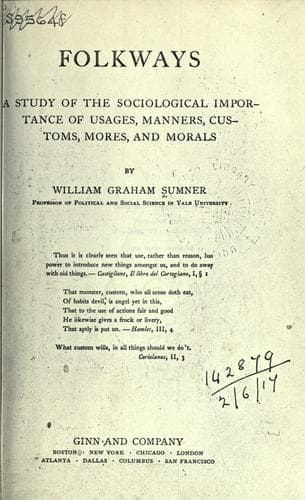
Folkways: A Study of the Sociological Importance of Usages, Manners, Customs, Mores, and MoralsSumner, William Graham
General
Folkways: A Study of the Sociological Importance of Usages, Manners, Customs, Mores, and Morals
Sumner, William Graham
Manners and customs
+24. Suggestion; suggestibility.+ What has been called the psychology of
crowds consists of certain phenomena of suggestion. A number of persons
assembled together, especially if they are enthused by the same
sentiment or stimulated by the same interest, transmit impulses to each
other with the result that all the impulses are increased in a very high
ratio. In other words, it is an undisputed fact that all mental states
and emotions are greatly increased in force by transmission from man to
man, especially if they are attended by a sense of the concurrence and
cooperation of a great number who have a common sentiment or interest.
"The element of psychic coercion to which our thought process is subject
is the characteristic of the operations which we call suggestive."[33]
What we have done or heard occupies our minds so that we cannot turn
from it to something else. The consensus of a number promises triumph
for the impulse, whatever it is. _Ca ira._ There is a thrill of
enthusiasm in the sense of moving with a great number. There is no
deliberation or reason. Therefore a crowd may do things which are either
better or worse than what individuals in it would do. Cases of lynching
show how a crowd can do things which it is extremely improbable that the
individuals would do or consent to, if they were taken separately. The
crowd has no greater guarantee of wisdom and virtue than an individual
would have. In fact, the participants in a crowd almost always throw
away all the powers of wise judgment which have been acquired by
education, and submit to the control of enthusiasm, passion, animal
impulse, or brute appetite. A crowd always has a common stock of
elementary faiths, prejudices, loves and hates, and pet notions. The
common stock is acted on by the same stimuli, in all the persons, at the
same time. The response, as an aggregate, is a great storm of feeling,
and a great impulse to the will. Hence the great influence of omens and
of all popular superstitions on a crowd. Omens are a case of "egoistic
reference."[34] An army desists from a battle on account of an eclipse.
A man starting out on the food quest returns home because a lizard
crosses his path. In each case an incident in nature is interpreted as a
warning or direction to the army or the man. Thus momentous results for
men and nations may be produced without cause. The power of watchwords
consists in the cluster of suggestions which has become fastened upon
them. In the Middle Ages the word "heretic" won a frightful suggestion
of base wickedness. In the seventeenth century the same suggestions were
connected with the words "witch" and "traitor." "Nature" acquired great
suggestion of purity and correctness in the eighteenth century, which it
has not yet lost. "Progress" now bears amongst us a very undue weight of
suggestion. Suggestibility is the quality of liability to suggestive
influence.[35] "Suggestibility is the natural faculty of the brain to
Public-domain text, read in full here on John Shaqi.
Reviews
Reviews
No reviews yet
Be the first to share your thoughts on this work.
Join the Discussion
Join the discussion
Sign in to leave a comment or review.
Sign InorCreate an account