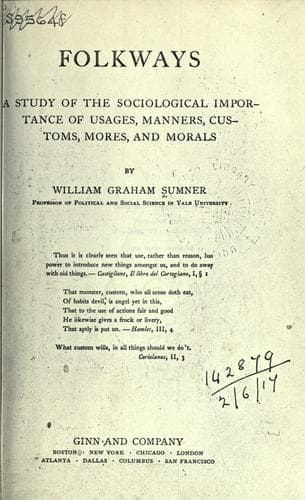
Folkways: A Study of the Sociological Importance of Usages, Manners, Customs, Mores, and MoralsSumner, William Graham
General
Folkways: A Study of the Sociological Importance of Usages, Manners, Customs, Mores, and Morals
Sumner, William Graham
Manners and customs
+291. Rise of the freedmen in industry.+ The freedmen were the ones who
were free from the old Roman contempt for productive labor. They seized
the chances for industry and commerce and amassed wealth. "Not only are
they crowding all the meaner trades [in the first and second centuries
of the Christian era], from which Roman pride shrank contemptuously,
but, by industry, shrewdness, and speculative daring, they are becoming
great capitalists and landowners on a senatorial scale."[787] "The
plebeian, saturated with Roman prejudice, looking for support to the
granaries of the state or the dole of the wealthy patron, turned with
disdain from the occupations which are in our days thought innocent, if
not honorable."[788] "After all reservations, the ascent of the freedmen
remains a great and beneficent revolution. The very reasons which made
Juvenal hate it most are its best justification to a modern mind. It
gave hope of a future to the slave. By creating a free industrial class
it helped to break down the cramped social ideal of the slave owner and
the soldier. It planted in every municipality a vigorous mercantile
class, who were often excellent and generous citizens. Above all, it
asserted the dignity of man."[789] But for the freedmen the society
seems to have contained but two classes,--"a small class of immensely
wealthy people, and an almost starving proletariat."[790]
+292. The freedmen in the state.+ Every despot needs ministers. The
history of all despotisms shows that they find those best suited to
their purpose in persons of humble rank. They can use such ministers
against nobles or other great men, and can command their complete
loyalty. Julius Caesar made some of his freedmen officers of the mint. It
was simply an extension of the usage of aristocratic households. The
emperor employed freedmen to write letters and administer the finances
of the empire as he would have used them to manage his private estate.
"Under Caligula, Claudius, and Nero, the imperial freedmen attained
their greatest ascendancy. Callistus, Narcissus, and Pallas rose to the
rank of great ministers, and, in the reign of Claudius, were practically
masters of the world. They accumulated enormous wealth by abusing their
power, and making a traffic in civic rights, in places, or
pardons."[791] The freedmen favorites carried the evil effects of
slavery on character to another stage and were agents of the corruption
of the new form of the state by the inheritance of slavery. "The women
of the freedmen class, for generations, wielded, in their own way, a
power which sometimes rivaled that of the men." They often had great
charms of person and mind. "Their morals were the result of an uncertain
social position, combined with personal attractions, and education."
Some of them did great mischief. Panthea, mistress of Lucius Verus, is
celebrated as one of the most beautiful women who ever lived. She had a
lovely voice, was fond of music and poetry, and had a very superior
Public-domain text, read in full here on John Shaqi.
Reviews
Reviews
No reviews yet
Be the first to share your thoughts on this work.
Elsewhere in the archive
Join the Discussion
Join the discussion
Sign in to leave a comment or review.
Sign InorCreate an account