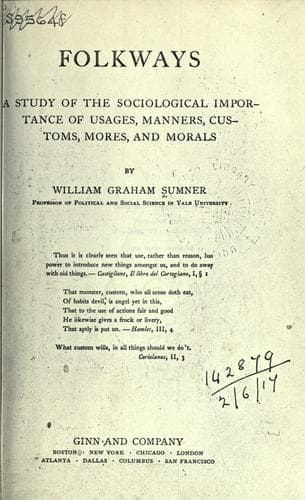
Folkways: A Study of the Sociological Importance of Usages, Manners, Customs, Mores, and MoralsSumner, William Graham
General
Folkways: A Study of the Sociological Importance of Usages, Manners, Customs, Mores, and Morals
Sumner, William Graham
Manners and customs
mind. She "never lost her natural modesty and simple sweetness."[792] In
the first century some freedmen married daughters of senatorial houses.
They were very able men. No others could have performed the duties of
the three great secretaryships,--appeals, petitions, and correspondence.
The fortunes of these men were often adventurous in the extreme, like
those of the ministers of sultans in the Arabian Nights. A slave,
advanced to a higher position in a household, then to a position of
confidence, where he proved his ability and devotion, got a great office
and became master of the world. Men of this kind have always been
refused social status.[793] In the second century the system was
changed, and knights became the great officers of administration.
+293. Philosophers opponents of slavery.+ The great neostoics of the
first century first denounced slavery and uttered the great humanitarian
doctrines. The real question in regard to Roman slavery was this: Is a
slave not a man? If he was one, he was either the victim of misfortune
or the inheritor of the misfortune of an ancestor. If he did not thereby
lose human status as a member of the race he deserved pity and help. The
humanitarian philosophy, therefore, had the simplest task and the most
direct application. Dio Chrysostom declared the evil effects of slavery
on the masters, sensuality, languor, and dependence. He pointed out the
wide difference between personal status and character,--the possible
nobility of a slave and the possible servility of a freeman.[794] Seneca
especially taught the abstract philosophy of liberalism, kindness, and
humanity. He represented a movement in public opinion. Pliny cultivated
all the graces of the debonair gentleman. Dill compares him to a "kindly
English squire." The inscriptions show that "his household was by no
means a rare exception."[795] Slaves had such perquisites and chances
that "the slave could easily purchase his own freedom." "The trusted
slave was often actually a partner, with a share of the profits of an
estate, or he had a commission on the returns."[796] Plutarch's whole
philosophy of life is gentle and kindly. It is unemotional and
nonstimulating. The neostoics had the character of an esoteric sect. We
never are sure that their writings are any more than rhetorical
exercises, or that they act or expect others to act by their precepts.
Slavery was such a fact in the social order that no one could conceive
of the abolition of it, or propose abolition as a thing within the scope
of statesmanship.
Public-domain text, read in full here on John Shaqi.
Reviews
Reviews
No reviews yet
Be the first to share your thoughts on this work.
Elsewhere in the archive
Join the Discussion
Join the discussion
Sign in to leave a comment or review.
Sign InorCreate an account