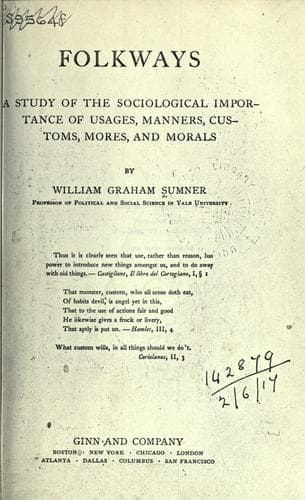
Folkways: A Study of the Sociological Importance of Usages, Manners, Customs, Mores, and MoralsSumner, William Graham
General
Folkways: A Study of the Sociological Importance of Usages, Manners, Customs, Mores, and Morals
Sumner, William Graham
Manners and customs
+294. The industrial colleges.+ The Romans had a genius for association
and organization. Under the republic artisans began to unite in
colleges. In the last century of the republic the political leaders took
alarm at these unions and forbade them. Caesar and Augustus abolished the
right of association. In the second century a certain number of
societies existed, in spite of prohibitions,--miners, salt workers,
bakers, and boatmen. Until Justinian all such unions were carefully
watched as dangerous to public peace and order. In the civil law they
were authorized, and made like natural persons.[797] The fashion of them
became very popular. "The colleges in which the artisans and traders of
the Antonine age grouped themselves are almost innumerable, even in the
records which time has spared. They represent almost every conceivable
branch of industry, or special skill, or social service."[798] "Men
formed themselves into these groups for the most trivial or whimsical
reasons, or for no reason at all, except that they lived in the same
quarter and often met. From the view which the inscriptions give us of
the interior of some of these clubs, it is clear that their main purpose
was social pleasure."[799] "And yet, many an inscription leaves the
impression that these little societies of the old pagan world are
nurseries, in an imperfect way, of gentle charities and
brotherliness."[800] They had many honorary members from among the
richer classes. Wandering merchants and military veterans, as well as
young men fond of sport, formed clubs on the same type. Alexander
Severus organized all the industrial colleges and assigned them
_defensores_. In the colleges all were equal, so that they were
educational in effect. "But these instances cannot make us forget the
cruel contempt and barbarity of which the slave was still the victim,
and which was to be his lot for many generations yet to run. Therefore
the improvement in the condition of the slave, or of his poor plebeian
brother, by the theoretical equality in the colleges may be easily
exaggerated."[801] The statesmen had feared that the artisans might use
their organization to interfere in politics. What happened in the fourth
century was that the state used the organizations to reduce the artisans
to servitude, and to subject them to heavy social obligations by law.
Public-domain text, read in full here on John Shaqi.
Reviews
Reviews
No reviews yet
Be the first to share your thoughts on this work.
Elsewhere in the archive
Join the Discussion
Join the discussion
Sign in to leave a comment or review.
Sign InorCreate an account